
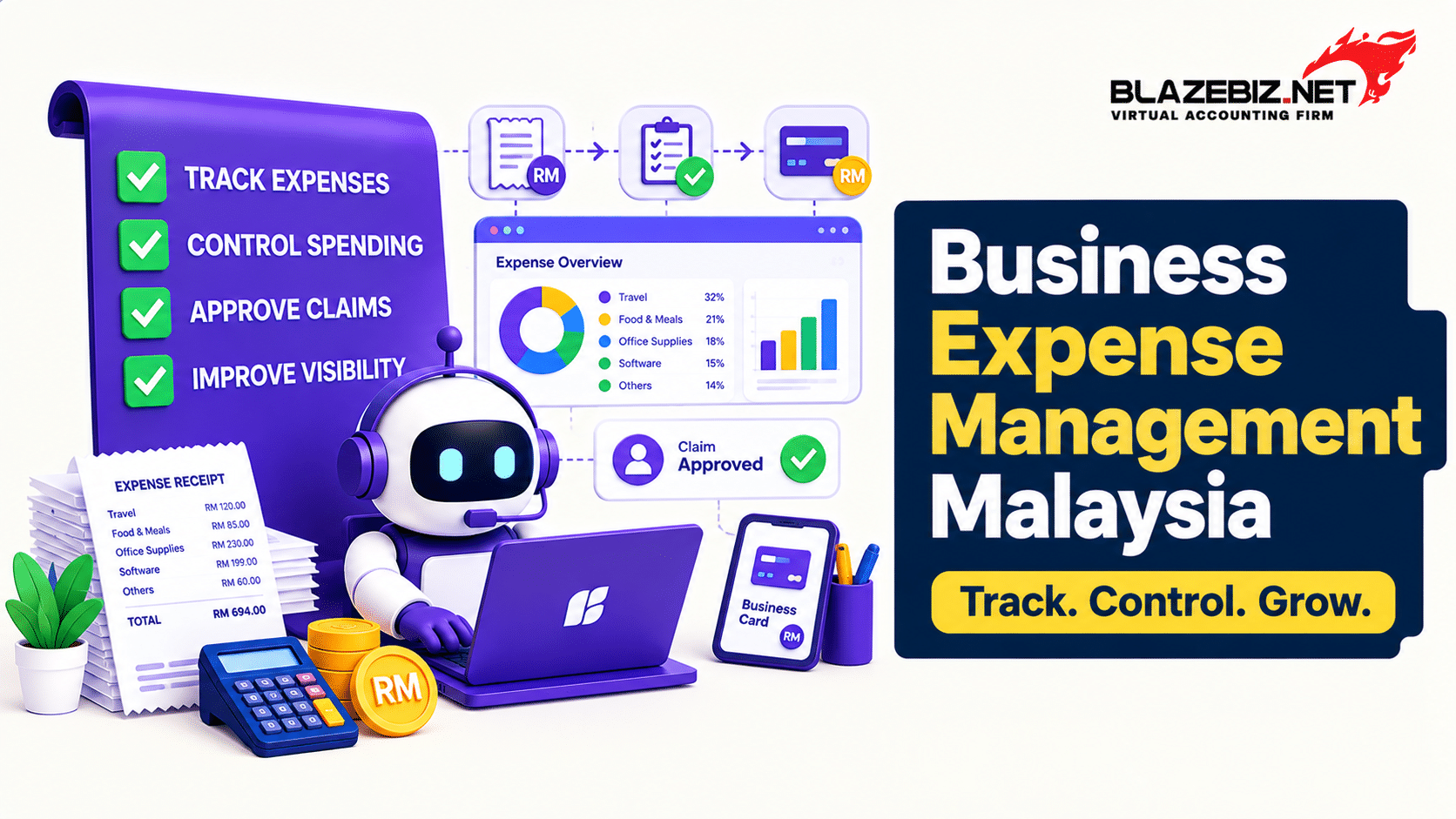
Business expenses can quickly become difficult to control as a Malaysian SME grows. Travel, software subscriptions, office costs, utilities, marketing, professional services and supplier payments can create hundreds of transactions each month.
Without a consistent expense management process, businesses may struggle to understand where money is being spent, identify unnecessary costs or prepare accurate financial reports.
A structured expense management process helps SMEs record, categorise, review and monitor business spending while keeping financial information organised.
What Is Business Expense Management?
Business expense management is the process of recording, categorising, reviewing and controlling the money a company spends to operate its business.
Expenses may include:
- Office rent
- Utilities
- Employee expenses
- Travel and accommodation
- Software subscriptions
- Marketing and advertising
- Professional fees
- Equipment and office supplies
- Telecommunication expenses
- Supplier purchases
The objective is not simply to reduce spending. It is to ensure that business expenses are properly recorded, reviewed and managed according to the company's financial requirements.
Why Expense Management Matters for Malaysian SMEs
Revenue alone does not show whether a business is performing well. Management also needs to understand how much it costs to generate that revenue.
Proper expense management can help SMEs:
- Understand where money is being spent
- Maintain more accurate accounting records
- Identify unusual or unnecessary expenses
- Monitor spending against budgets
- Prepare more reliable financial reports
- Improve cash-flow visibility
- Organise supporting documents
- Make better-informed business decisions
For growing businesses, these benefits become more important as transaction volumes increase.
Common Expense Management Problems for SMEs
1. Expenses Are Recorded Late
When expenses are entered weeks or months after they occur, financial records may not accurately reflect the company's current position.
2. Receipts and Documents Are Difficult to Find
Receipts may be stored in emails, paper files, messaging apps or individual employee folders. Finding supporting documents later can become time-consuming.
3. Expenses Are Categorised Incorrectly
Incorrect categorisation can affect management reports and make it harder to understand spending by expense type.
4. Personal and Business Spending Gets Mixed
Mixing personal and business transactions can make bookkeeping more complicated and reduce the clarity of business financial records.
5. Too Much Reliance on Spreadsheets
Spreadsheets can be useful for basic tracking, but multiple files and manual updates can become difficult to maintain as the number of transactions grows.
6. No Regular Expense Review
If expenses are only reviewed when preparing financial statements, management may miss spending trends or unusual transactions until much later.
How to Manage Business Expenses More Effectively
SMEs can improve expense management by creating a consistent process for recording and reviewing business spending.
1. Create Clear Expense Categories
Use a consistent set of expense categories that matches the way the business operates.
For example, categories may include:
- Rent
- Utilities
- Advertising
- Travel
- Office expenses
- Professional fees
- Software and subscriptions
- Repairs and maintenance
- Employee-related expenses
A consistent chart of accounts makes it easier to compare expenses over different periods and prepare financial reports.
2. Record Expenses Promptly
Record expenses as soon as practical instead of allowing transactions to accumulate.
Regular updates give management a clearer view of current spending and reduce the risk of missing transactions.
3. Keep Supporting Documents Organised
Maintain appropriate supporting documents for business expenses and establish a consistent process for storing and retrieving them.
Depending on the transaction, supporting information may include:
- Invoices
- Receipts
- Payment records
- Purchase documents
- Expense claims
- Other relevant supporting records
4. Set Approval Procedures
Growing businesses can benefit from clear approval procedures for employee expenses, purchases and larger payments.
Approval limits can be designed according to the company's size, responsibilities and internal controls.
5. Review Expenses Regularly
Review expenses regularly rather than waiting until year-end.
Look for:
- Unexpected increases
- Duplicate transactions
- Unusual spending
- Recurring subscriptions
- Unnecessary costs
- Expenses outside approved categories
6. Compare Expenses Over Time
Comparing monthly or quarterly expenses can help management identify spending patterns.
For example, a sudden increase in advertising, utilities or travel expenses may require further investigation.
Manual Expense Tracking vs Accounting Software
| Area | Manual Tracking | Accounting Software |
|---|---|---|
| Expense recording | Often entered manually into spreadsheets | Recorded within the accounting system |
| Expense categories | May vary between files or users | Can follow a structured chart of accounts |
| Reporting | May require manual calculations | Reports can be generated from recorded transactions |
| Data consistency | Depends heavily on manual entry | Uses structured accounting records |
| Transaction review | Often requires checking multiple files | Can be reviewed within the accounting system |
| Scalability | Becomes harder as transactions increase | Designed to manage larger volumes of structured transactions |
The right approach depends on the size and complexity of the business. However, accounting software can reduce the amount of manual work involved in maintaining financial records.
How Accounting Software Helps Track Expenses
Accounting software provides a structured environment for recording business transactions and generating financial information.
Depending on the software and configuration, businesses can use accounting systems to:
- Record business expenses
- Assign transactions to appropriate accounts
- Manage supplier transactions
- Track customer payments
- Record bank transactions
- Reconcile financial records
- Generate expense reports
- Prepare profit and loss reports
- Review financial information by reporting period
This creates a centralised record of financial transactions instead of relying on multiple spreadsheets.
BlazeBiz provides SQL Accounting Software for Malaysian businesses with general ledger, customer, supplier, purchase, sales and financial reporting functions.
How Expense Management Supports Cash-Flow Control
Expense management and cash flow are closely connected because business spending represents cash leaving the company.
When management knows what has been spent and what payments are coming up, it becomes easier to plan short-term cash requirements.
Businesses can monitor:
- Recurring expenses
- Upcoming supplier payments
- Employee expense claims
- Monthly operating costs
- Large planned purchases
- Outstanding expenses
- Expected customer collections
Accurate bank reconciliation also helps maintain confidence in recorded cash balances. See our guide on bank reconciliation for Malaysian SMEs.
How to Build an SME Expense Management Process
A simple expense management workflow can be structured around the following steps:
- Define the business expense categories.
- Set rules for employee and business expenses.
- Determine which expenses require approval.
- Collect and organise supporting documents.
- Record transactions promptly.
- Review expenses for accuracy.
- Reconcile relevant bank transactions.
- Monitor spending against budgets where applicable.
- Review expense reports regularly.
- Investigate unusual or unexpected transactions.
The process can be adjusted as the company grows and its financial controls become more detailed.
Expense Management Checklist for Malaysian SMEs
- Are all business expenses recorded?
- Are expenses assigned to consistent categories?
- Are supporting documents properly maintained?
- Are employee expense claims reviewed?
- Are duplicate expenses checked?
- Are unusual transactions investigated?
- Are recurring subscriptions reviewed?
- Are supplier expenses recorded promptly?
- Are bank transactions reconciled regularly?
- Are expense trends reviewed by management?
How Often Should SMEs Review Business Expenses?
There is no single review schedule that suits every business. The appropriate frequency depends on transaction volume, business size and internal controls.
Businesses with frequent transactions may review expenses weekly, while smaller businesses may use a monthly review process.
The important point is to review spending regularly enough to identify errors, unusual transactions and changes in operating costs before they become difficult to investigate.
How Expense Tracking Improves Financial Reporting
Financial reports are only as useful as the underlying accounting records.
If expenses are missing, duplicated or incorrectly categorised, the resulting reports may not provide a reliable picture of business performance.
Consistent expense recording supports reports such as:
- Profit and loss statements
- Balance sheets
- Expense reports
- Cash-flow information
- General ledger reports
- Accounts payable reports
For more information, read How to Prepare Accurate Financial Reports Faster.
Can Automation Make Expense Management Easier?
Automation can reduce repetitive administrative work involved in processing financial transactions.
Depending on the tools being used, automation may help with transaction processing, invoice information, bank reconciliation, expense categorisation and financial reporting.
AI-based accounting tools may also help identify unusual transactions or categorise certain financial information, but financial records should still be reviewed by the appropriate person.
Read more about how AI can reduce accounting errors for Malaysian SMEs.
Frequently Asked Questions
What is business expense management?
Business expense management is the process of recording, categorising, reviewing and controlling company spending to maintain organised financial records and improve spending visibility.
Why is expense management important for SMEs?
Expense management helps SMEs understand where money is being spent, maintain accurate accounting records, identify unusual spending and improve financial visibility.
How can SMEs track expenses?
SMEs can track expenses by using consistent categories, recording transactions promptly, maintaining supporting documents and reviewing expenses regularly through spreadsheets or accounting software.
Can accounting software track business expenses?
Yes. Accounting software can provide structured tools for recording business transactions, categorising expenses and generating financial reports. Available functions depend on the software and configuration.
How does expense management affect cash flow?
Business expenses represent cash outflows. Tracking spending and upcoming payments helps management understand cash requirements and plan working capital more effectively.
How often should business expenses be reviewed?
The appropriate frequency depends on transaction volume and business requirements. Many businesses benefit from weekly or monthly reviews so unusual transactions and spending changes can be identified earlier.
Can AI help with expense management?
AI-powered accounting tools can assist with tasks such as transaction analysis, expense categorisation and identifying unusual activity. Businesses should still review important financial information before making accounting or financial decisions.
Improve Expense Management with BlazeBiz
Effective expense management is about more than reducing costs. It is about knowing where business money is going and maintaining reliable financial records.
For Malaysian SMEs, a consistent process combined with suitable accounting software can make it easier to record expenses, monitor spending, reconcile transactions and prepare financial reports.
BlazeBiz provides SQL Accounting solutions for Malaysian businesses, helping companies manage accounting transactions and financial information in a structured system.
If your business still relies heavily on spreadsheets to track expenses, it may be time to review whether a dedicated accounting system can simplify your financial workflow.
Talk to BlazeBiz about SQL Accounting and build a more organised expense management process for your business.
