
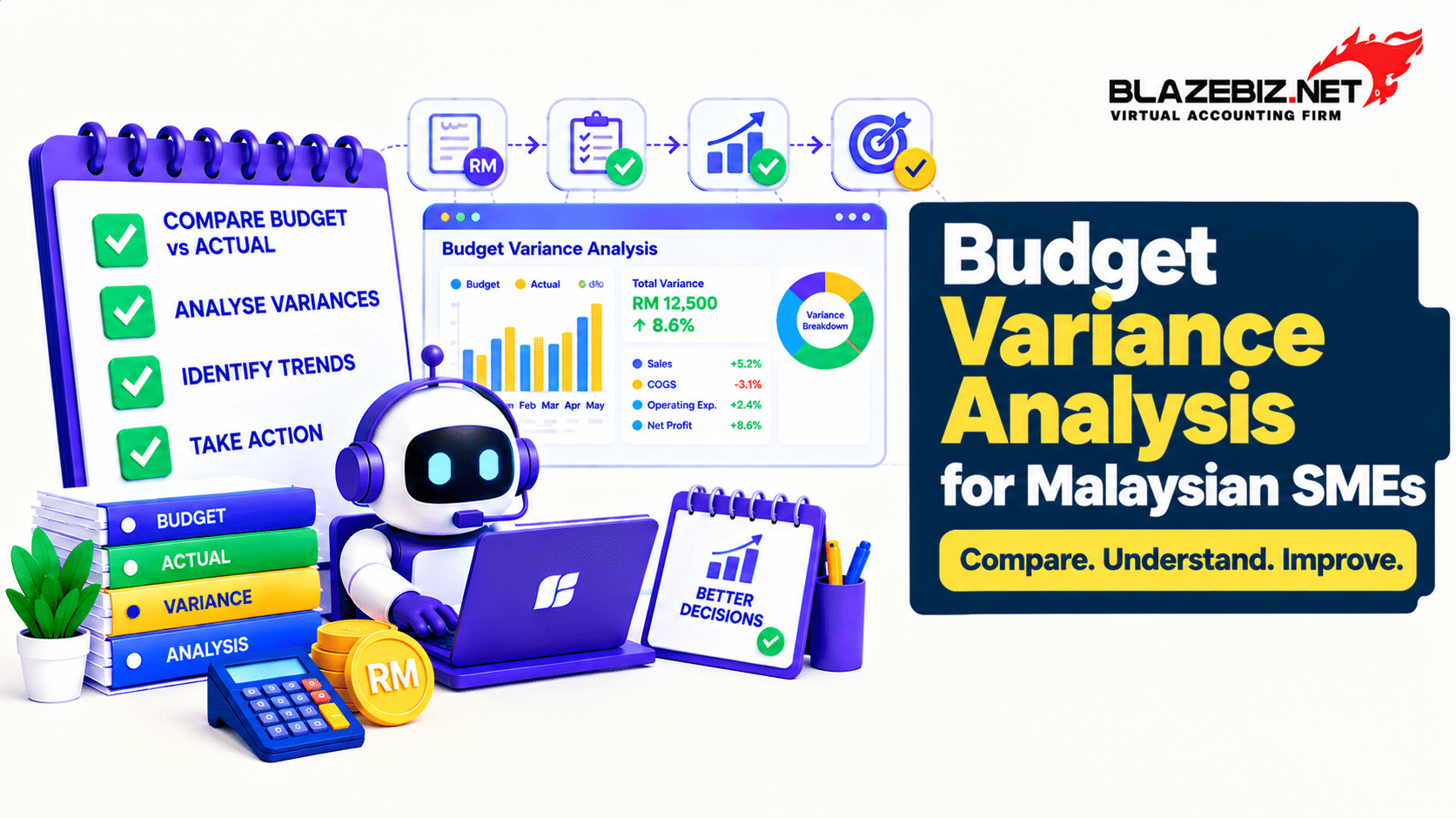
Preparing a business budget helps Malaysian SMEs set financial targets, plan expenses and allocate resources. However, preparing a budget is only the first step. Businesses also need to compare their actual financial results against those targets to understand whether performance is on track.
Budget variance analysis helps business owners identify differences between planned and actual revenue, expenses and profit. It can reveal unexpected costs, lower-than-expected sales and opportunities to improve financial performance.
In this guide, we explain how budget variance analysis works, how to calculate variances and how Malaysian SMEs can use the results to make more informed business decisions.
What Is Budget Variance Analysis?
Budget variance analysis is the process of comparing budgeted financial figures with actual results over a specific period. The comparison helps management understand where performance differs from the original plan and whether further investigation is needed.
For example, a Malaysian SME may budget RM60,000 in monthly sales but achieve only RM52,000. The RM8,000 difference is a sales variance that management can investigate.
Similarly, if the business budgets RM15,000 for operating expenses but spends RM18,000, expenses are RM3,000 above budget. The next step is to identify why the difference occurred and whether it requires corrective action.
A variance does not automatically mean that business performance is poor. The reason behind the difference, its financial impact and whether it is temporary or recurring are all important.
Why Budget Variance Analysis Matters for Malaysian SMEs
SMEs often operate with limited financial resources, making it important to understand how actual results compare with business plans. Without regular reviews, unexpected expenses or declining sales may continue for several months before management notices the problem.
A structured variance analysis process can help businesses:
- Identify revenue that falls below expectations.
- Detect unexpected increases in operating expenses.
- Understand changes in gross profit and net profit.
- Review purchasing and inventory costs.
- Improve future budgeting and financial forecasts.
- Make better-informed spending decisions.
- Recognise positive results and opportunities to grow.
The goal is not simply to explain differences in a report. It is to use financial information to understand what is happening and decide what action, if any, is appropriate.
How to Calculate Budget Variances
The basic formula for calculating a budget variance is:
Budget Variance = Actual Result − Budgeted Result
For example, if actual revenue is RM52,000 and budgeted revenue is RM60,000:
RM52,000 − RM60,000 = −RM8,000
Revenue is RM8,000 below budget.
For expenses, the same formula can be used, but the interpretation is different. If actual expenses exceed the budget, the business has an unfavourable expense variance unless the additional spending is justified by a corresponding benefit or other business consideration.
Percentage variance can also help management understand the size of a difference relative to the budget.
Percentage Variance = (Actual Result − Budgeted Result) ÷ Budgeted Result × 100%
If actual revenue is RM52,000 against a budget of RM60,000, the variance is approximately −13.33%.
Percentage comparisons should be interpreted carefully when the budgeted amount is zero or very small. In these cases, the percentage may be meaningless or misleading.
Favourable vs Unfavourable Variances
A favourable variance generally means a result is better than the budgeted target, while an unfavourable variance means it is worse than expected. However, the interpretation depends on the financial measure being reviewed.
| Financial item | Example | Possible interpretation |
|---|---|---|
| Revenue | Actual sales exceed budget | Generally favourable |
| Operating expenses | Actual expenses exceed budget | Generally unfavourable |
| Gross profit | Actual gross profit is below budget | Generally unfavourable |
| Marketing expenses | Spending exceeds budget and generates profitable new sales | Requires further analysis |
| Inventory purchases | Purchases exceed budget due to higher customer demand | Review alongside sales and stock levels |
For example, spending less than budget on marketing may appear favourable. However, if the reduction results in lower sales and fewer new customers, the overall business outcome may be worse.
Business owners should therefore review variances in context rather than assuming every underspend is good and every overspend is bad.
Practical Budget Variance Example for a Malaysian SME
Consider a Malaysian trading business that compares its monthly budget with actual results.
| Financial item | Budget | Actual | Variance |
|---|---|---|---|
| Revenue | RM60,000 | RM52,000 | −RM8,000 |
| Cost of goods sold | RM36,000 | RM33,800 | −RM2,200 |
| Gross profit | RM24,000 | RM18,200 | −RM5,800 |
| Operating expenses | RM15,000 | RM18,000 | +RM3,000 |
| Operating profit | RM9,000 | RM200 | −RM8,800 |
In this example, revenue is RM8,000 below budget, while operating expenses are RM3,000 above budget. Although the cost of goods sold is lower than budget, gross profit has fallen because the reduction in revenue is greater than the reduction in costs.
Operating profit is also significantly below the target. Management should investigate the sales shortfall, changes in product mix, purchasing costs and the reasons for higher operating expenses before deciding on corrective action.
The figures are illustrative. Actual results will depend on the business’s transactions, accounting policies and the way its budget is prepared.
7 Steps to Perform Budget Variance Analysis
1. Prepare a Clear Business Budget
A useful variance analysis starts with a realistic budget. Set targets for revenue, direct costs, operating expenses, staffing, inventory purchases and other important financial items.
Use historical results, expected customer demand, planned business activities and known cost changes to develop your estimates. Make sure the budget period and accounting categories match the reports you intend to compare.
If your business is preparing its annual financial plan, read our guide to business budgeting for Malaysian SMEs.
2. Collect Accurate Actual Financial Data
Actual figures should come from reliable accounting records. Missing invoices, duplicate transactions, unrecorded expenses or unreconciled bank transactions can make comparisons less useful.
Record transactions consistently and complete the necessary checks before preparing the variance report. Confirm that revenue, expenses and other balances are assigned to the correct accounting period.
Accurate financial reports help management identify genuine differences rather than errors in the underlying data. Learn more about preparing accurate financial reports faster.
3. Compare Budgeted and Actual Results
Compare actual results with the budget for the same period. A monthly comparison can help identify recent changes, while a year-to-date comparison provides a broader view of performance.
Review both the monetary variance and the percentage variance where meaningful. A RM500 difference may be significant for a small expense category but relatively minor for a large revenue category.
Use consistent accounting categories so that each budget item can be compared with the corresponding actual figure.
4. Identify Significant Variances
Not every difference requires a detailed investigation. Set reasonable review thresholds based on the size of the business, the financial item and its potential effect on profit or cash flow.
For example, management may choose to investigate expense variances above a specified amount or percentage. Critical items such as payroll, major supplier costs and regulatory obligations may require review even when the variance is relatively small.
Use thresholds as a guide rather than a substitute for judgement. A series of small differences can also indicate a recurring problem.
5. Investigate the Root Cause
Once a significant variance is identified, determine why it occurred. Avoid changing the budget or cutting costs before understanding the cause.
Possible reasons include:
- Sales volumes or selling prices changed.
- Supplier prices increased.
- Customer demand differed from expectations.
- Additional staff or overtime were required.
- One-off repairs or maintenance costs occurred.
- Purchases or expenses were recorded in a different period.
- Inventory losses, wastage or stock adjustments affected costs.
Where possible, compare the current period with previous months, review supporting documents and speak with the employees responsible for the activity.
6. Take Corrective Action Where Necessary
After identifying the cause, decide whether action is needed. Depending on the situation, the business may revise purchasing plans, review selling prices, improve sales activities, investigate supplier charges or adjust discretionary spending.
Assign responsibility for each action and set a date to review progress. For example, if a recurring expense exceeds budget, a manager can review the supplier contract and report the outcome during the next financial meeting.
Do not automatically cut spending that supports essential operations or profitable sales. Corrective action should address the underlying problem while protecting the long-term needs of the business.
7. Update Future Budgets and Forecasts
Budgets are based on estimates, and business conditions can change. Use the findings from variance analysis to improve future assumptions and forecasts.
If customer demand is consistently higher or lower than expected, update the sales forecast. If supplier prices have changed, reflect the new costs in purchasing plans where appropriate.
Keep a record of major changes and the reasons behind them. This helps management distinguish between unexpected events and recurring planning issues.
Common Budget Variance Analysis Mistakes
Malaysian SMEs can reduce the usefulness of their analysis when they:
- Compare actual figures with an outdated or unrealistic budget.
- Use inconsistent reporting periods or accounting categories.
- Focus only on the total variance without investigating individual items.
- Assume every expense overspend is unnecessary.
- Ignore small variances that occur repeatedly.
- Make decisions using incomplete or unreconciled records.
- Identify problems but do not assign follow-up actions.
- Change the budget to hide poor performance instead of explaining the difference.
A useful variance analysis should explain what changed, why it changed, how it affects the business and what management plans to do next.
How Often Should SMEs Review Budget Variances?
The appropriate review frequency depends on transaction volume, business complexity and the level of financial risk.
- Weekly: Review urgent cash, sales or spending issues when the business needs close monitoring.
- Monthly: Compare revenue, expenses, gross profit and operating profit against the monthly budget.
- Quarterly: Review broader performance trends and whether business targets remain realistic.
- Annually: Use the results to improve the next year’s budget and financial plans.
A monthly review is a useful starting point for many SMEs. Businesses facing tight cash flow, seasonal demand or significant cost changes may need more frequent checks.
How Accounting Software Can Help with Budget Variance Analysis
Budget variance analysis depends on having organised financial information that can be compared consistently. When sales, purchases, expenses and other transactions are recorded in a structured accounting system, businesses can reduce the manual work involved in preparing their reports.
Depending on the selected software, modules and configuration, useful capabilities may include:
- Generating profit and loss reports for selected periods.
- Reviewing revenue and expense transactions by account.
- Monitoring customer balances and supplier obligations.
- Maintaining inventory and purchase records.
- Comparing financial reports across periods.
- Exporting data for budgeting and variance analysis.
Businesses should confirm whether their accounting software supports the budget reports and comparisons they need. Some workflows may require spreadsheets, additional modules or a separate budgeting tool.
BlazeBiz provides SQL Accounting solutions for Malaysian businesses. Review the available reporting functions and configuration options to determine whether they fit your budgeting and financial monitoring process.
Frequently Asked Questions
What is budget variance analysis?
Budget variance analysis compares budgeted financial figures with actual results. It helps businesses identify differences in revenue, expenses and profit, investigate the causes and decide whether corrective action is needed.
How do you calculate a budget variance?
Subtract the budgeted result from the actual result. For example, actual revenue of RM52,000 minus budgeted revenue of RM60,000 gives a negative variance of RM8,000.
What is a favourable budget variance?
A favourable variance generally means the actual result is better than budgeted. Higher-than-expected revenue may be favourable, while lower expenses may be favourable if they do not harm business performance or future growth.
How often should a business perform variance analysis?
Many SMEs start with a monthly review. Businesses with high transaction volumes, tight cash flow or significant changes in costs and sales may benefit from more frequent monitoring.
Why do actual expenses exceed the budget?
Expenses may exceed budget because of supplier price increases, unexpected repairs, higher staffing costs, additional business activity or incorrect budget assumptions. Reviewing the underlying transactions helps identify the actual cause.
Can accounting software help with budget variance analysis?
Accounting software can organise transaction records and generate financial reports used in variance analysis. The available budget comparison features depend on the selected software, version, modules and configuration.
Improve Financial Planning with BlazeBiz
Budget variance analysis helps Malaysian SMEs move beyond setting financial targets to understanding actual business performance. By comparing budgeted and actual results, investigating significant differences and reviewing corrective actions, businesses can make better-informed financial decisions.
The process works best when budgets are realistic, accounting records are up to date and management reviews the results consistently. Even a straightforward monthly report can reveal issues that might otherwise go unnoticed.
BlazeBiz supports Malaysian businesses with accounting solutions that help organise transactions and financial reporting. Explore SQL Accounting to learn more about the available features for your business.
Compare your budget with actual results regularly, understand the reasons behind the differences and use those findings to plan the next step for your business.
