A business can have strong sales and still struggle to pay its suppliers, employees or monthly bills. This often happens when customer payments arrive late, expenses fall due before cash is collected, or too much money is tied up in inventory.
For Malaysian small and medium-sized enterprises (SMEs), cash flow forecasting is an important way to anticipate these challenges before they affect daily operations. It helps business owners estimate how much money will come in, how much will go out and whether sufficient cash will be available when payments are due.
In this guide, we explain how to prepare a practical cash flow forecast, understand the numbers and use the forecast to make better financial decisions.
What Is Cash Flow Forecasting?
Cash flow forecasting is the process of estimating the cash a business expects to receive and pay over a future period. It uses information such as customer payment dates, supplier invoices, payroll, rent, loan repayments and planned purchases.
A cash flow forecast focuses on the timing of actual cash movements rather than only the revenue and expenses recorded in your accounts.
For example, your business may issue an invoice worth RM20,000 in January, but the customer may only pay in February. The sale may be recorded in January, while the cash becomes available in February. This difference can affect your ability to pay January expenses.
A forecast helps you identify these timing gaps and plan how to manage them.
Why Is Cash Flow Forecasting Important for Malaysian SMEs?
Cash flow affects a business's ability to operate smoothly. Even profitable businesses can experience financial pressure when money is collected too slowly or expenses increase unexpectedly.
Cash flow forecasting can help your business:
- Anticipate cash shortages: Identify periods when available funds may not cover upcoming payments.
- Manage supplier payments: Plan purchases and payment dates around expected cash receipts.
- Improve customer collections: Identify overdue invoices that could affect your cash position.
- Prepare for payroll: Set aside sufficient funds for salaries and applicable statutory contributions.
- Plan investments: Evaluate whether you can afford new equipment, additional staff or business expansion.
- Reduce financial uncertainty: Make decisions using expected cash movements instead of guesswork.
How to Prepare a Cash Flow Forecast in 6 Steps
1. Start With Your Current Cash Balance
Begin by identifying how much cash your business currently has available. Review your bank accounts and cash records, and account for any payments or transfers that have not yet been reflected in your records.
Use a reconciled figure where possible. This gives you a more reliable starting point and helps reduce the risk of planning around money that is not actually available.
Remember to distinguish available cash from funds that are restricted, committed to specific purposes or needed to cover payments already due.
Regular bank reconciliation helps maintain accurate cash records. Read our guide on how to automate bank reconciliation for Malaysian SMEs.
2. Estimate Your Expected Cash Inflows
Next, estimate when money is expected to enter your business. Do not rely only on your sales target or the total value of invoices issued. Consider when customers are likely to pay.
Common cash inflows include:
- Payments from customers
- Cash and card sales
- Customer deposits and advance payments
- Loan proceeds or approved financing
- Capital introduced by business owners
- Other expected business receipts
For credit sales, review invoice due dates and the payment behaviour of individual customers. If a customer regularly pays two weeks late, consider that pattern when estimating the likely collection date.
Our guide on tracking outstanding customer payments explains how businesses can improve visibility over unpaid invoices and follow-up activities.
3. List Your Expected Cash Outflows
Record the payments your business expects to make during the forecast period. Use actual payment schedules, supplier terms and known commitments wherever possible.
Typical cash outflows include:
- Supplier and inventory payments
- Employee salaries and applicable payroll contributions
- Rent, utilities and internet bills
- Marketing and operating expenses
- Loan instalments and interest payments
- Taxes and other applicable statutory payments
- Equipment purchases and planned investments
Be careful not to count the same payment twice. For example, if a supplier invoice is already included in your accounts payable schedule, do not add it again as a separate general expense in the forecast.
Review upcoming supplier obligations and payment dates. Our article on accounts payable management in Malaysia may also help you organise supplier payments.
4. Calculate Your Projected Cash Balance
Once you have estimated your inflows and outflows, calculate the expected cash balance at the end of each period.
Basic cash flow forecast formula:
Closing Cash Balance = Opening Cash Balance + Expected Cash Inflows − Expected Cash Outflows
The closing balance for one period becomes the opening balance for the next period. This helps you see how your cash position may change over time.
If the forecast shows a negative balance or a balance below the amount your business needs to operate safely, investigate the timing gap before it occurs.
5. Prepare for Different Business Scenarios
Customer payment dates and business expenses do not always follow your original plan. Prepare alternative scenarios to understand how changes could affect your cash position.
- Expected scenario: Customer payments and expenses follow your most realistic estimates.
- Conservative scenario: Some customers pay late, sales are lower or costs increase.
- Improved scenario: Customers pay earlier or sales generate more cash than expected.
For example, if your business depends on a few large customers, test what would happen if one significant invoice were paid a month later than expected. This helps you decide whether you need to maintain a larger cash reserve or arrange backup financing.
6. Review and Update the Forecast Regularly
A cash flow forecast should change as new information becomes available. Update it when customers make payments, suppliers change terms, new expenses arise or business conditions shift.
Review the forecast at least weekly if your cash position is tight or transactions change frequently. A monthly review may be sufficient for some businesses with more predictable cash movements, supported by regular monitoring of major payments.
Compare expected receipts and payments with what actually happened. Investigate significant differences and adjust future estimates so that the forecast becomes more useful over time.
Cash Flow Forecast Example for a Malaysian SME
Consider a small Malaysian trading business that wants to estimate its cash position for March. The following figures are illustrative and assume all amounts are in Malaysian ringgit (RM).
Cash Flow Item March Estimate Opening cash balance RM20,000 Expected customer collections RM35,000 Other cash receipts RM2,000 Total available cash RM57,000 Supplier payments RM20,000 Salaries and payroll-related payments RM12,000 Rent and utilities RM4,000 Other operating payments RM6,000 Total cash outflows RM42,000 Projected closing cash balance RM15,000
Based on these estimates, the business expects to finish March with RM15,000 in cash. This is calculated by adding the opening balance and expected receipts, then deducting the planned payments.
However, if RM10,000 of expected customer collections is delayed until April, the March closing balance could fall to RM5,000, assuming the other figures remain unchanged.
This illustrates why payment timing matters. The business may need to follow up on overdue invoices, discuss payment schedules with suppliers or postpone non-essential spending if the lower balance is insufficient for upcoming commitments.
This example is a simplified forecast, not a guarantee of future cash availability. Actual results depend on payment timing and any additional cash movements not included in the table.
Common Cash Flow Problems SMEs Should Watch For
Several common business practices can create cash flow pressure even when sales appear healthy.
Late Customer Payments
When customers pay after the agreed due date, your business may have to cover operating expenses before receiving the cash from completed sales. Use clear payment terms, monitor overdue invoices and follow up consistently.
Excessive Inventory
Buying more stock than you need can tie up cash in products that may take months to sell. Review sales patterns, stock turnover and reorder quantities to keep inventory aligned with actual demand. Learn more in our guide to inventory management for Malaysian SMEs.
Unplanned Expenses
Repairs, equipment replacements, urgent purchases and unexpected operating costs can reduce available cash. Review major spending decisions before committing and maintain a suitable cash reserve where possible.
Poor Visibility Over Financial Records
Incomplete records make it harder to know which invoices remain unpaid, which supplier bills are due and how much cash is available. Keep your records updated and reconcile bank transactions regularly so your forecast is based on reliable information.
Practical Ways to Improve Business Cash Flow
Once you understand your forecast, use it to take action rather than simply monitor the numbers.
- Improve collection procedures: Issue invoices promptly, set clear payment terms and follow up on overdue accounts.
- Review supplier terms: Discuss payment schedules that suit your cash cycle while maintaining good supplier relationships.
- Control operating expenses: Review recurring costs and prioritise spending that supports business operations.
- Manage inventory carefully: Avoid tying up too much money in slow-moving products or unnecessary purchases.
- Plan large purchases: Check the effect of equipment purchases and expansion plans on future cash balances.
- Maintain a cash buffer: Set a reserve based on your business's operating costs, payment patterns and risk exposure.
- Monitor financial reports: Review cash balances, receivables, payables and operating performance regularly.
How Accounting Software Can Help With Cash Flow Forecasting
Preparing a forecast manually can become difficult when a business handles many customer invoices, supplier bills, bank transactions and branches. If the underlying records are incomplete or outdated, the forecast may also be unreliable.
Accounting software can help organise financial transactions, track outstanding customer balances, monitor supplier obligations and produce reports that support cash flow planning.
For Malaysian SMEs, SQL Accounting can support day-to-day accounting and financial reporting workflows. Businesses should assess the reporting features and setup available in their chosen system to determine how best to use the information for forecasting.
Accurate financial information is essential for effective planning. Read our guide on preparing accurate financial reports faster to learn how better record-keeping can support business decisions.
Software can reduce manual work and improve visibility, but forecasts still require realistic assumptions and regular reviews by the people managing the business.
Frequently Asked Questions
1. What is the purpose of cash flow forecasting?
Cash flow forecasting helps a business estimate future cash receipts and payments. It can identify potential cash shortages early, support payment planning and help business owners make informed financial decisions.
2. How far ahead should an SME forecast its cash flow?
Many SMEs benefit from maintaining a rolling forecast covering the next 8 to 13 weeks, alongside a broader monthly view for the coming year. The appropriate period depends on business complexity, payment cycles and how quickly conditions change.
3. What is the difference between cash flow forecasting and budgeting?
A budget estimates planned income, expenses and financial performance over a period. A cash flow forecast focuses on when cash is expected to enter and leave the business. Both are useful because a business may record sales before receiving payment.
4. Can a profitable business still have cash flow problems?
Yes. A business may record a profit but lack enough available cash to meet payments when they fall due. This can happen when customers pay late, inventory purchases are high or major expenses occur before cash is collected.
5. How often should a business update its cash flow forecast?
Update the forecast when significant new information becomes available and review it regularly. Weekly reviews can be useful for businesses with tight cash flow or frequent transactions, while businesses with predictable cash movements may use a monthly review supported by ongoing payment monitoring.
6. Can accounting software help with cash flow management?
Yes. Accounting software can help organise transactions, track outstanding invoices, monitor supplier balances and generate financial reports. These records can support cash flow forecasting when they are accurate, up to date and reviewed regularly.
Final Thoughts
Cash flow forecasting helps Malaysian SMEs understand whether enough money is likely to be available to meet future business commitments. By tracking expected receipts, planning payments and reviewing cash balances regularly, business owners can identify potential problems before they become urgent.
Start with your current cash balance, use realistic payment dates and update your forecast as circumstances change. Combine this process with effective customer collection, expense control and accurate financial records to build a more resilient business.
Looking to improve your financial visibility and accounting processes? Explore BlazeBiz to learn more about accounting solutions for Malaysian businesses.
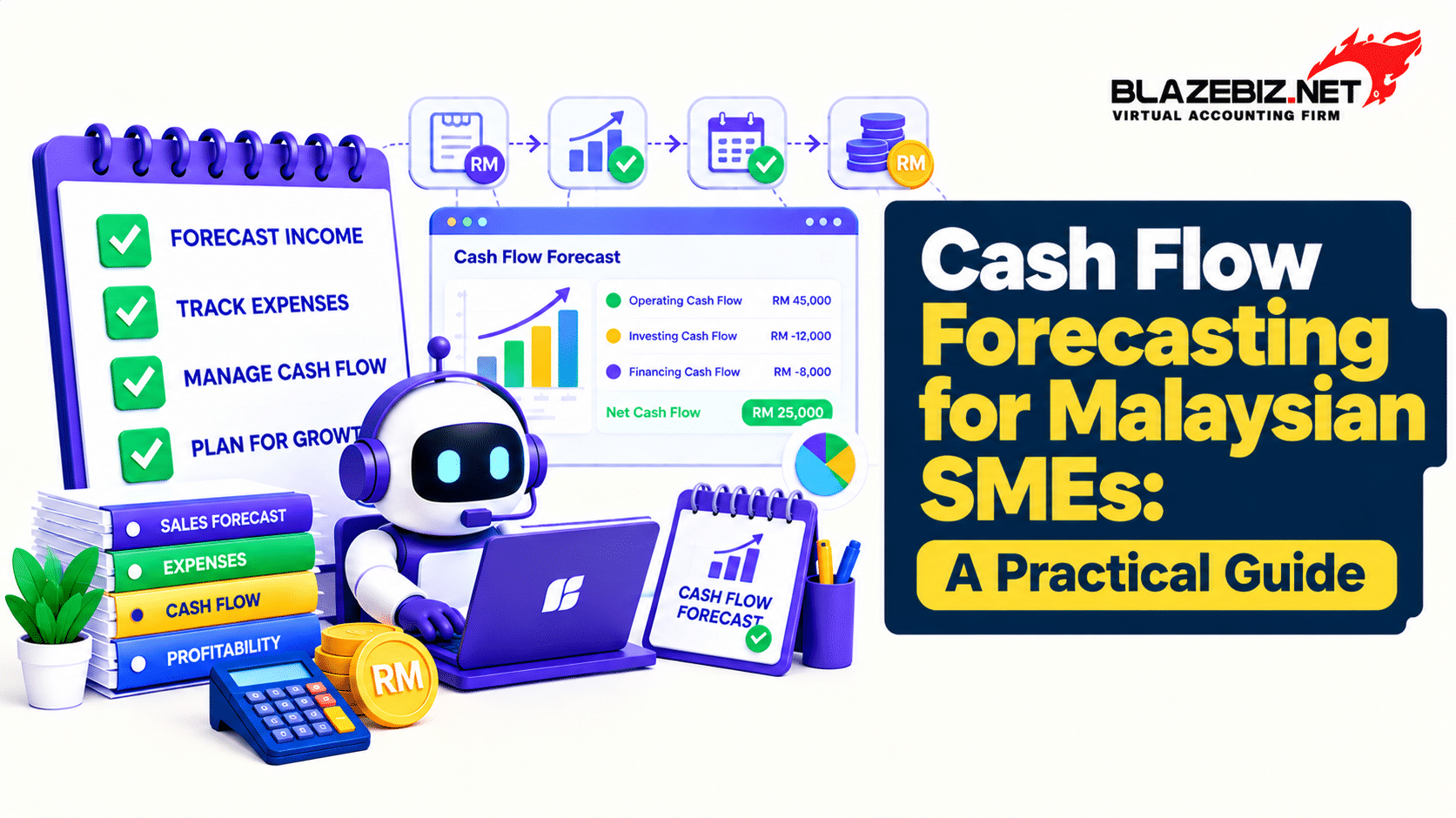
Cash Flow Forecasting for Malaysian SMEs: A Practical Guide
Cash Flow Forecasting for Malaysian SMEs: A Practical Guide
Published Date: October 14, 2026

Our Business is to
Simplify Yours
Our Business is to Simplify Yours
We stress very much on customer service and support – we understand that end-users need their queries attended to in a timely manner, and so we place a high level of resources to ensure you get the assistance you demand for in our company.

Explore
© All rights reserved. • Blazebiz Innovate Sdn Bhd | 202101032194 (1432494-V)