
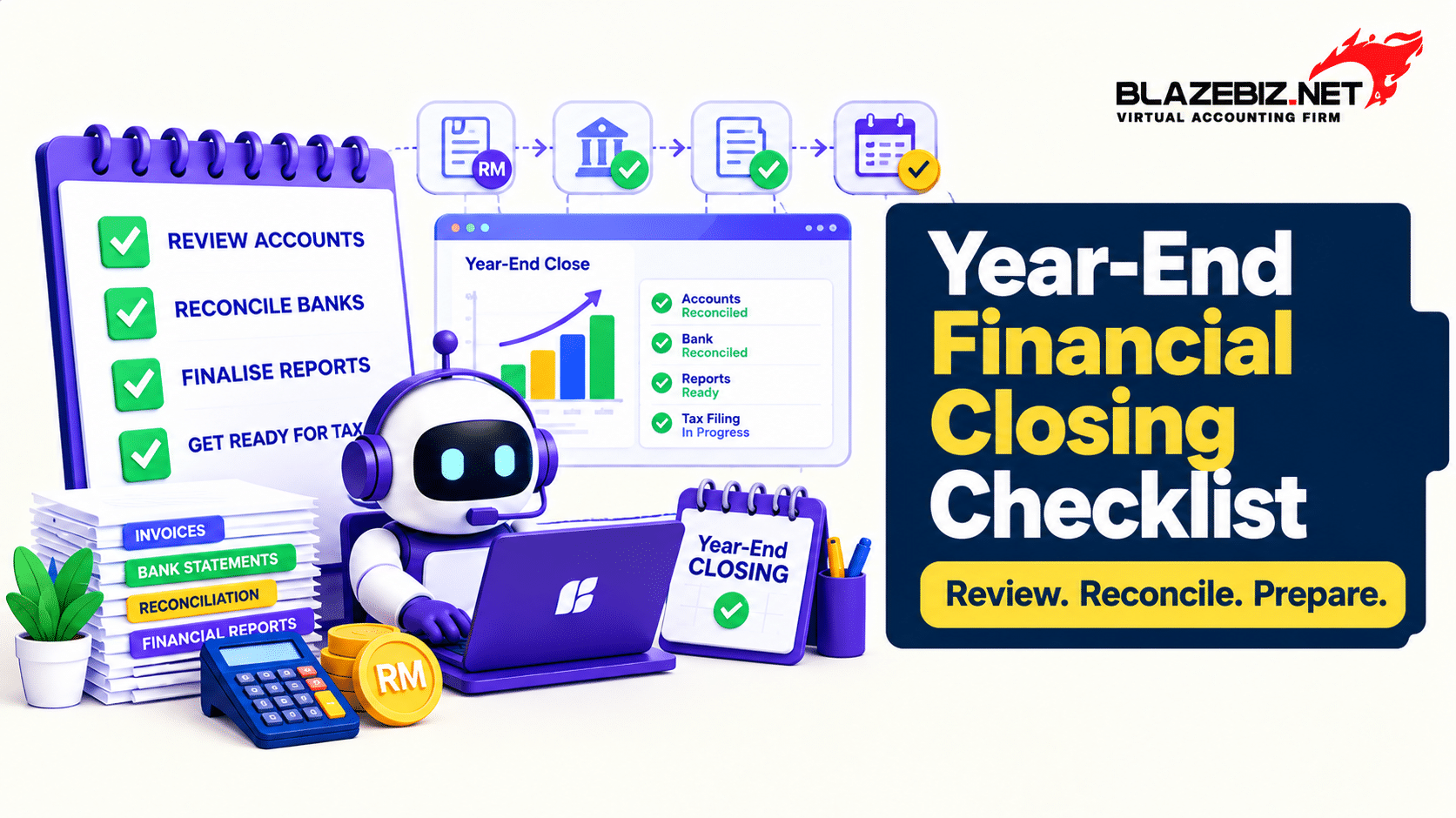
Year-end financial closing is an important task for every Malaysian small and medium-sized enterprise (SME). It helps business owners confirm their financial position, identify outstanding payments, review expenses and prepare accurate financial reports.
A structured year-end financial closing checklist can make the process easier, reduce errors and help your accountant prepare the necessary records for tax and statutory requirements.
What Is Year-End Financial Closing?
Year-end financial closing is the process of reviewing and finalising a business’s financial records at the end of its accounting period. It involves checking transactions, reconciling accounts, reviewing assets and liabilities, and preparing financial statements. For Malaysian SMEs, a proper closing process also helps organise supporting documents for tax preparation, audit requirements where applicable, and company reporting obligations.Why Is Year-End Closing Important for SMEs?
Accurate year-end records help business owners understand performance and make informed decisions. A consistent closing process can help you:- Identify missing transactions and accounting errors.
- Confirm outstanding customer payments and supplier balances.
- Review business expenses and profitability.
- Check inventory records against actual stock.
- Prepare reliable profit and loss statements and balance sheets.
- Organise financial documents for tax filing and audit preparation, where applicable.
- Plan cash flow and budgets for the next financial year.
Year-End Financial Closing Checklist for Malaysian SMEs
Use the following checklist to review your accounting records before finalising the financial year.1. Review Sales and Income Records
Check that all sales, service income, credit notes and other business revenue have been recorded correctly. Compare sales reports with invoices, receipts and relevant supporting documents.- Confirm that sales invoices are recorded in the correct accounting period.
- Check for missing, duplicated or cancelled invoices.
- Review credit notes and sales returns.
- Match sales records with available payment and bank records.
2. Reconcile Bank Accounts
Compare your accounting records with bank statements to identify differences. Review outstanding deposits, unpresented payments, bank charges, interest and unidentified transactions. Complete bank reconciliation for every business bank account. For practical guidance, read our article on automating bank reconciliation in Malaysia.3. Check Outstanding Customer Payments
Review accounts receivable to identify invoices that remain unpaid. Confirm customer balances and follow up on overdue payments before closing the year.- Generate an aged receivables report.
- Identify overdue invoices and disputed balances.
- Follow up with customers on payment commitments.
- Review doubtful debts and discuss any required accounting adjustments with your accountant.
4. Verify Supplier Payments and Expenses
Review accounts payable to ensure supplier invoices, expenses and other liabilities are recorded in the correct period. Compare supplier statements with your accounting records and investigate differences.- Confirm outstanding supplier invoices.
- Check recurring expenses and unpaid bills.
- Verify staff claims and business reimbursements.
- Review duplicate invoices and payments.
- Ensure expenses are supported by appropriate documents.
5. Verify Inventory and Stock Balances
Businesses that hold inventory should compare physical stock with accounting records. Investigate damaged, missing, obsolete or slow-moving items and ensure stock adjustments are properly documented. Accurate inventory records help businesses calculate the cost of goods sold and understand their financial position. See our guide to inventory management in Malaysia for practical inventory control tips.6. Review Payroll and Employee Expenses
Check payroll records, salaries, allowances, deductions, bonuses and outstanding employee claims. Reconcile payroll expenses with the general ledger and confirm that applicable statutory contributions and reporting obligations have been addressed. Keep payroll reports and supporting records organised. Businesses using payroll software can simplify payroll reporting and record retrieval through SQL Payroll.7. Review Fixed Assets and Depreciation
Check the records for business equipment, computers, vehicles, machinery and other fixed assets. Record relevant purchases and disposals, verify asset details and review depreciation entries with your accountant.- Update the fixed asset register.
- Confirm asset purchases and disposals.
- Check asset descriptions and acquisition dates.
- Review depreciation and related accounting adjustments.
8. Reconcile Loans, Deposits and Other Balances
Review balance sheet accounts, including business loans, deposits, prepayments, accrued expenses and other liabilities. Compare balances with relevant statements and supporting documents, and investigate unexplained differences. Correctly reconciled balances help ensure that your financial statements reflect the business’s position more accurately.9. Organise Tax and Compliance Documents
Gather invoices, receipts, bank statements, payroll reports, expense records and other supporting documents required for accounting and tax preparation. Keep records organised and retain them in accordance with the applicable Malaysian requirements. Depending on the business structure and circumstances, additional tax, audit or statutory reporting obligations may apply. Check the relevant requirements with your accountant and the appropriate Malaysian authorities, including Lembaga Hasil Dalam Negeri Malaysia (HASiL) and the Companies Commission of Malaysia (SSM).10. Prepare and Review Financial Reports
Once reconciliations and adjustments are completed, generate and review the key financial reports for the accounting period.- Profit and Loss Statement: Reviews revenue, expenses and profit or loss.
- Balance Sheet: Shows assets, liabilities and equity.
- Cash Flow Report: Helps assess cash inflows and outflows.
- Trial Balance: Helps identify discrepancies in ledger balances.
- Accounts Receivable and Payable Reports: Summarise customer and supplier balances.
11. Set Priorities for the Next Financial Year
Use your year-end reports to plan the next financial year. Review business performance, cash flow, outstanding debts, inventory requirements and operating costs.- Set realistic revenue and profit targets.
- Prepare a working capital budget.
- Review customer credit terms and collection processes.
- Identify unnecessary or rising expenses.
- Plan inventory purchases and major business investments.
How Accounting Software Can Simplify Year-End Closing
When financial information is spread across spreadsheets, emails and separate systems, year-end closing can become time-consuming. Accounting software helps centralise records and makes it easier to retrieve transaction details and review financial reports. With an accounting system such as SQL Accounting, SMEs can manage customer and supplier accounts, inventory, general ledger transactions and financial reporting in one system. This can reduce repetitive manual work and improve visibility over the accounts. Explore SQL Accounting solutions from BlazeBiz to learn how accounting software can support your business processes.Common Year-End Closing Mistakes to Avoid
- Leaving bank reconciliation until the last minute.
- Failing to follow up on overdue customer invoices.
- Recording expenses or income in the wrong accounting period.
- Ignoring differences between physical inventory and system records.
- Missing supporting documents for transactions.
- Preparing financial reports without reviewing account balances.
- Failing to back up accounting data and organise financial records.
