
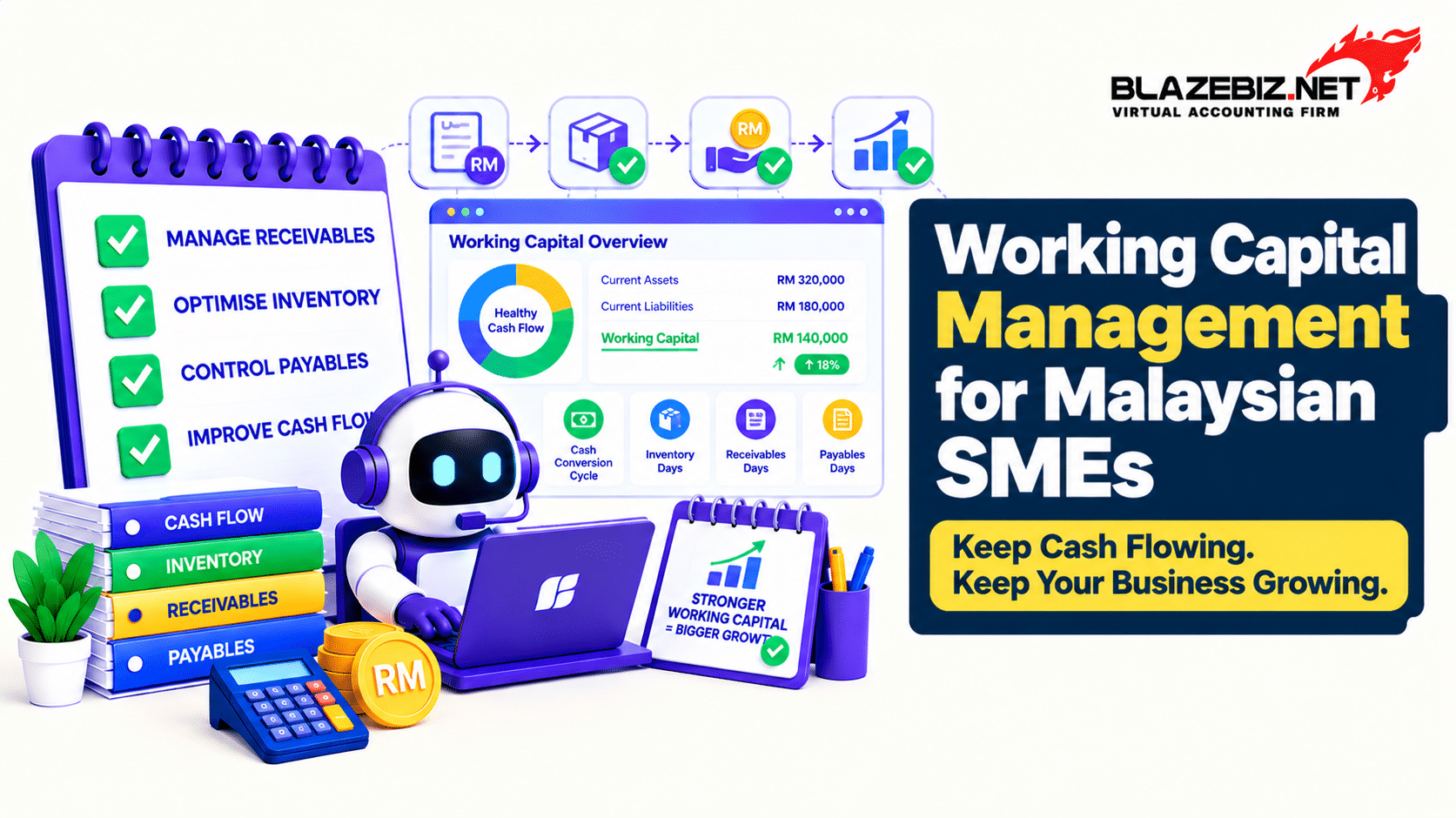
Working capital plays an important role in keeping a business running smoothly. A company may generate sales and report a profit, but it can still face financial pressure if it does not have enough short-term resources to pay suppliers, employees, rent and other operating expenses.
For Malaysian small and medium-sized enterprises (SMEs), effective working capital management helps balance money coming into the business with the funds required to support daily operations. It also helps business owners make better decisions about purchasing, customer credit, inventory and upcoming payments.
This guide explains what working capital means, how to calculate it and how Malaysian SMEs can improve it through practical financial management and accounting processes.
What Is Working Capital?
Working capital is the difference between a business’s current assets and current liabilities. It provides an indication of whether the business has sufficient short-term resources to meet its short-term obligations.
Current assets commonly include:
- Cash and bank balances
- Customer payments due to the business
- Inventory held for sale or business operations
- Other assets expected to be converted into cash or used within the normal operating cycle or relevant short-term period
Current liabilities commonly include:
- Supplier invoices payable
- Short-term loans and borrowings
- Accrued operating expenses
- Other obligations due within the relevant short-term period
The exact classification of assets and liabilities depends on the applicable accounting framework and the business’s circumstances.
How to Calculate Working Capital
The working capital formula is straightforward:
Working Capital = Current Assets − Current Liabilities
For example, imagine a Malaysian trading business has the following balances:
| Item | Amount |
|---|---|
| Cash and bank balances | RM25,000 |
| Outstanding customer payments | RM30,000 |
| Inventory | RM20,000 |
| Total current assets | RM75,000 |
| Supplier payments due | RM18,000 |
| Short-term loan obligations | RM12,000 |
| Other current liabilities | RM5,000 |
| Total current liabilities | RM35,000 |
| Working capital | RM40,000 |
The business has RM40,000 in positive working capital. This indicates that its current assets exceed its current liabilities by that amount.
However, positive working capital does not automatically mean the business has RM40,000 available in cash. Some current assets may be tied up in inventory or customer invoices that have not yet been paid.
Why Working Capital Management Matters for Malaysian SMEs
Small businesses often operate with limited financial reserves. A delayed customer payment, unexpected repair or large supplier invoice can affect the funds available for normal operations.
Good working capital management helps businesses:
- Maintain sufficient funds for day-to-day expenses.
- Plan supplier payments and purchasing commitments.
- Reduce the amount of cash tied up in slow-moving inventory.
- Follow up on overdue customer invoices.
- Identify potential cash shortages earlier.
- Make better decisions about expansion, hiring and equipment purchases.
Working capital should be monitored alongside profitability and cash flow. These measures provide different information, and reviewing them together gives management a clearer picture of the business’s financial position.
Working Capital vs Cash Flow
Working capital and cash flow are related, but they are not the same.
Working capital measures the difference between current assets and current liabilities at a particular point in time. Cash flow measures money moving into and out of the business over a period.
For example, a business may record RM30,000 in customer invoices as current assets. If customers have not paid yet, that amount may increase working capital without increasing the cash currently available in the bank.
This is why business owners should review working capital together with bank balances, expected receipts and upcoming payments. For more detail, read our guide to cash flow forecasting for Malaysian SMEs.
7 Ways to Improve Working Capital Management
1. Collect Customer Payments on Time
Outstanding customer invoices can tie up money that the business needs for operating expenses. Even when sales are strong, delayed collections may create pressure on the bank balance.
To improve collections:
- Issue accurate invoices promptly.
- Communicate payment terms clearly before completing a sale.
- Review overdue invoices regularly.
- Follow up with customers before and after payment due dates.
- Investigate disputed invoices quickly.
A regular collection process helps the business identify overdue balances before they become more difficult to recover. Read our guide on how to track outstanding customer payments effectively.
2. Manage Inventory Carefully
Inventory can represent a significant portion of current assets for retailers, wholesalers and trading businesses. However, products that remain unsold for long periods can tie up cash that could otherwise support daily operations.
Review stock movement and purchasing patterns to understand which items sell quickly and which remain on the shelves. Set suitable reorder levels, monitor slow-moving products and avoid purchasing excessive quantities simply to obtain a discount.
The objective is to maintain enough stock to meet customer demand without committing more cash than necessary. Learn more in our guide to inventory management in Malaysia.
3. Plan Supplier Payments
Supplier payments are a major part of working capital management. Paying invoices before they are due may reduce available cash unnecessarily, while late payments can damage supplier relationships or interrupt deliveries.
Maintain an up-to-date list of supplier invoices, payment terms and due dates. Schedule payments according to agreed terms, available cash and business priorities. Always resolve discrepancies before releasing payment.
For practical steps, see our article on accounts payable management for Malaysian SMEs.
4. Prepare a Short-Term Cash Flow Forecast
A cash flow forecast helps management estimate when money is expected to enter and leave the business. It can highlight periods when customer collections may not be sufficient to cover supplier invoices, salaries, rent or loan repayments.
Start by recording the opening cash balance, expected customer receipts and planned payments. Update the forecast regularly using actual results and revised payment dates.
A forecast does not eliminate uncertainty, but it gives management more time to respond to a possible cash shortage. Read our guide to cash flow forecasting for a step-by-step approach.
5. Review Expenses and Purchasing Commitments
Unplanned spending can reduce the cash available for essential operating activities. Review recurring subscriptions, overheads, supplier costs and planned purchases to identify opportunities to improve spending decisions.
Before committing to a major purchase, consider its urgency, expected business benefit and effect on upcoming cash requirements. Avoid delaying essential maintenance or purchases that protect operations simply to preserve cash in the short term.
A structured expense review can help management distinguish essential costs from spending that can be reduced, rescheduled or better controlled. See our guide to business expense management in Malaysia.
6. Monitor Working Capital Regularly
Working capital should not be reviewed only at year-end. Regular monitoring helps management identify changes in customer balances, inventory, supplier obligations and short-term liabilities.
Useful measures include:
- Working capital: Current assets minus current liabilities.
- Current ratio: Current assets divided by current liabilities.
- Quick ratio: Cash, cash equivalents, short-term investments where applicable, and eligible receivables divided by current liabilities, based on the business’s chosen definition.
- Receivables ageing: The amount customers owe, grouped by how long invoices have been outstanding.
- Inventory movement: How quickly stock is sold or used during a period.
No single measure tells the whole story. For example, a strong current ratio may be less reassuring if a large proportion of current assets consists of slow-moving inventory or overdue receivables.
7. Keep Financial Records Up to Date
Working capital calculations are only useful when the underlying records are reasonably complete and accurate. Missing invoices, unrecorded payments and outdated inventory figures can distort the business’s financial position.
Record sales, purchases, expenses, receipts and payments promptly. Reconcile bank transactions and review customer and supplier balances regularly. Investigate unusual differences rather than carrying them forward without explanation.
Accurate accounting records give management a stronger basis for cash planning, budgeting and financial decisions. Our guide on preparing accurate financial reports faster explains how a more structured process can help.
Practical Example: Improving Working Capital
Consider a Malaysian SME with current assets of RM75,000 and current liabilities of RM35,000. Its working capital is RM40,000.
The business then identifies RM8,000 in overdue customer invoices and RM6,000 in slow-moving inventory. It follows up on the overdue invoices and sells the slow-moving stock at appropriate prices.
If the business collects RM8,000 in receivables, cash increases by RM8,000 while receivables decrease by the same amount. Total current assets and working capital do not change from that collection alone, but the business has more cash available to pay its obligations.
If the business also sells inventory at its recorded carrying value and receives cash, the composition of its current assets changes from inventory to cash. Working capital remains broadly unchanged before considering any selling costs, profit or loss, taxes and other effects.
This example highlights an important distinction: improving liquidity does not always mean increasing working capital. Converting assets into cash and timing payments appropriately can make existing working capital more useful for daily operations.
Common Working Capital Mistakes to Avoid
Malaysian SMEs can make working capital management more difficult when they:
- Focus on sales growth without monitoring customer collections.
- Purchase more inventory than demand justifies.
- Make supplier payments without reviewing upcoming cash needs.
- Use outdated spreadsheets to estimate current assets and liabilities.
- Confuse accounting profit with available cash.
- Ignore short-term loan repayments and accrued expenses.
- Review financial performance only at the end of the year.
Avoiding these mistakes requires consistent record-keeping, clear responsibilities and regular financial reviews rather than relying on the bank balance alone.
How Accounting Software Supports Working Capital Management
Accounting software can help SMEs organise the financial information needed to monitor working capital. When transactions are recorded consistently, business owners can review customer balances, supplier obligations, purchases, expenses and financial reports in a more structured way.
Depending on the selected software, modules and configuration, useful functions may include:
- Customer invoicing and receivables tracking.
- Supplier accounts and purchase records.
- Inventory records and stock movement reporting.
- Bank transaction recording and reconciliation.
- Current asset and liability reporting.
- Profit and loss statements and balance sheets.
These records can help management identify outstanding obligations and understand how sales, inventory and supplier transactions affect the business’s short-term financial position.
BlazeBiz provides SQL Accounting solutions for Malaysian businesses. Businesses can review the available accounting and reporting functions to determine whether they fit their working capital management requirements.
Frequently Asked Questions
What is working capital in simple terms?
Working capital is the difference between current assets and current liabilities. It helps show whether a business’s short-term assets exceed its short-term obligations.
What is the working capital formula?
The formula is current assets minus current liabilities. For example, current assets of RM75,000 less current liabilities of RM35,000 give working capital of RM40,000.
Is positive working capital always good?
Positive working capital generally means current assets exceed current liabilities. However, its quality also matters. Slow-moving inventory and overdue customer invoices may limit the cash available to meet immediate payments.
How can Malaysian SMEs improve working capital?
SMEs can improve working capital management by collecting customer payments promptly, controlling inventory, planning supplier payments, reviewing expenses, preparing cash flow forecasts and keeping accounting records up to date.
How often should working capital be reviewed?
The appropriate frequency depends on transaction volume, cash reserves and business risks. Many SMEs benefit from reviewing key balances monthly, with more frequent checks when cash flow is tight or transactions are high-volume.
What is the difference between working capital and cash flow?
Working capital measures current assets minus current liabilities at a particular point in time. Cash flow tracks money entering and leaving the business over a period. Both are important for understanding short-term financial health.
Can accounting software help with working capital management?
Yes. Accounting software can organise receivables, payables, purchases, inventory and financial reports. The usefulness of the information depends on accurate transaction recording and regular review.
Improve Working Capital Management with BlazeBiz
Effective working capital management helps Malaysian SMEs understand their short-term financial commitments and make better decisions about collections, purchasing and spending.
By monitoring current assets and liabilities, keeping inventory under control and maintaining accurate accounting records, businesses can identify potential financial pressure earlier and plan their operations more confidently.
BlazeBiz supports Malaysian businesses with accounting solutions designed to organise financial transactions and reporting. Explore SQL Accounting to learn more about the available features for your business.
A consistent working capital review, supported by reliable financial information, can help your business stay better prepared for its day-to-day obligations and future growth.
