
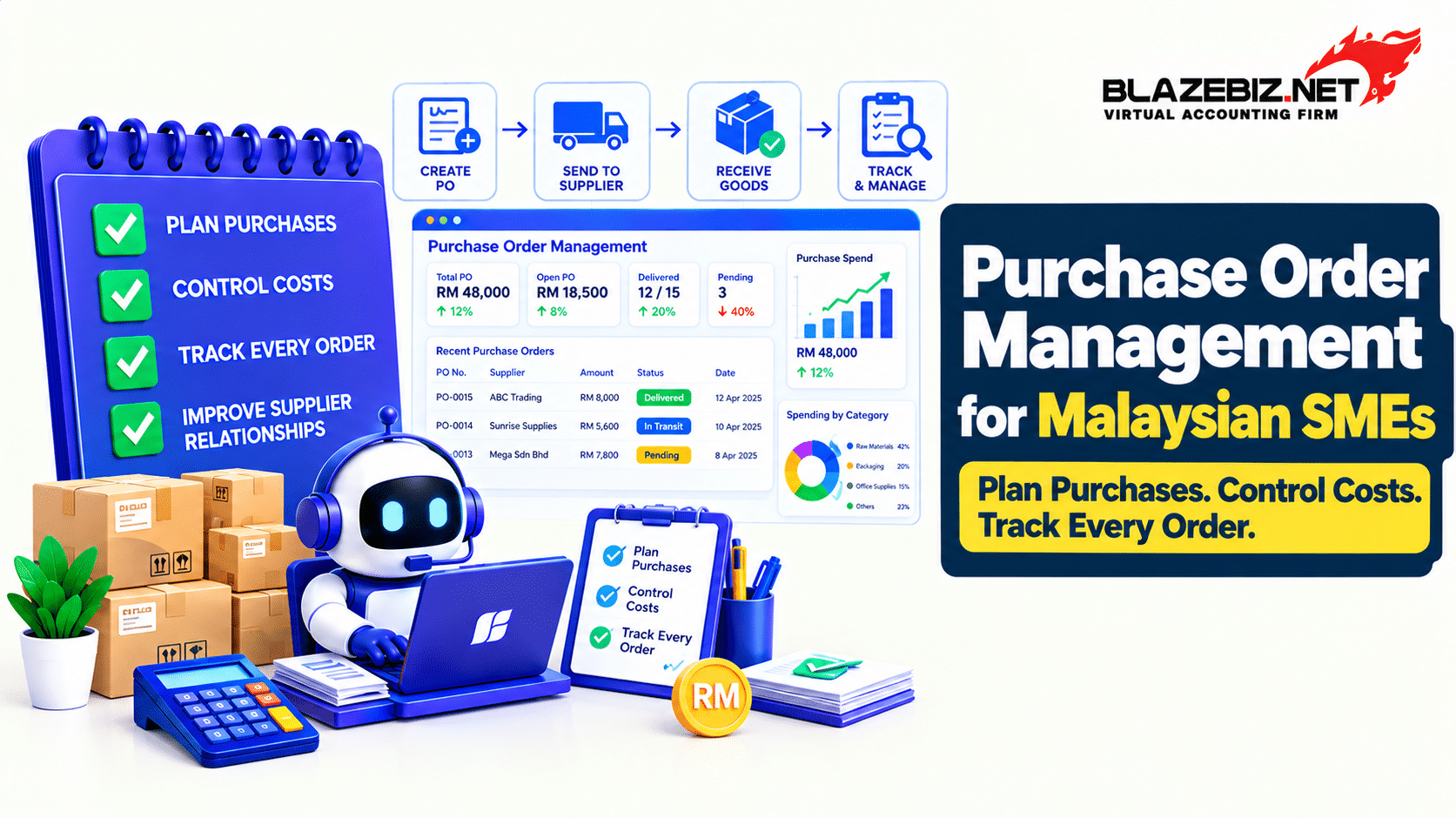
Purchasing is an essential part of running a business, whether an SME buys inventory for resale, raw materials for production or services for daily operations. Without a clear purchasing process, businesses may experience duplicate orders, unexpected expenses, delayed deliveries and difficulty tracking supplier commitments.
Purchase order management helps Malaysian small and medium-sized enterprises (SMEs) organise purchasing activities from the initial request through approval, delivery and invoice verification. It gives business owners better visibility into what has been ordered, how much it costs and when goods or services are expected.
In this guide, we explain what purchase order management is, how the process works and how Malaysian SMEs can use practical purchasing controls to improve cost management, inventory planning and financial record-keeping.
What Is Purchase Order Management?
Purchase order management is the process of creating, approving, issuing, tracking and closing purchase orders for goods or services a business intends to buy.
A purchase order (PO) is a document sent by a buyer to a supplier that specifies the items or services being ordered, quantities, agreed prices and other relevant terms. Once accepted under the applicable agreement, it helps both parties understand the order requirements.
A purchase order commonly includes:
- Purchase order number and issue date.
- Supplier name and relevant contact details.
- Description of goods or services.
- Quantities, unit prices and total amounts.
- Delivery address and expected delivery date.
- Applicable taxes, charges and agreed terms.
- Internal approval details, where required.
The exact information required depends on the type of purchase, the supplier agreement and the business’s internal procedures. A consistent PO process makes it easier to track commitments and resolve differences between orders, deliveries and invoices.
Why Purchase Order Management Matters for Malaysian SMEs
Many SMEs begin with informal purchasing arrangements, such as sending orders through email or messaging applications. These methods can work for simple transactions, but they become harder to control when order volumes increase or several employees purchase on behalf of the business.
A structured purchase order process helps businesses:
- Control spending before orders are placed.
- Reduce duplicate or unauthorised purchases.
- Track expected deliveries and outstanding orders.
- Compare supplier prices and purchasing terms.
- Coordinate purchasing with inventory requirements.
- Check supplier invoices against approved orders and goods received.
- Maintain clearer records for budgeting and financial reporting.
These controls are particularly useful when a business has multiple branches, several purchasing employees or frequent inventory replenishment. They help management understand what the business has committed to spend, even before supplier invoices arrive.
Purchase Order vs Purchase Requisition vs Supplier Invoice
These documents serve different purposes in the purchasing process. Understanding the differences helps businesses establish clear responsibilities and avoid confusion.
| Document | Purpose | Typical stage |
|---|---|---|
| Purchase requisition | Requests approval to buy goods or services | Before an order is approved |
| Purchase order | Records the goods or services being ordered from a supplier | After the required approval |
| Delivery note or receiving record | Documents goods delivered or received | When goods arrive |
| Supplier invoice | Requests payment for goods or services supplied | After invoicing by the supplier |
| Payment record | Documents settlement of the supplier obligation | When payment is made |
Not every business needs a separate requisition for every purchase. The process can be proportionate to the size and risk of the transaction. However, businesses should establish clear approval rules and maintain sufficient supporting records.
How the Purchase Order Process Works
A standard purchase order process follows a series of steps designed to ensure that purchases are necessary, approved, correctly received and properly recorded.
1. Identify the Purchasing Requirement
The process starts when an employee or department identifies a need for goods or services. This may involve replenishing inventory, buying office supplies, purchasing equipment or engaging an external service provider.
Before requesting a purchase, check existing stock, outstanding orders and available budgets. This helps prevent unnecessary purchases and reduces the risk of ordering items that are already available.
2. Obtain Quotes and Select a Supplier
For purchases where price or supplier selection is important, compare quotations and relevant terms before making a decision. Consider more than the quoted price alone.
Factors to review may include product quality, delivery lead time, payment terms, warranty coverage, reliability and any additional charges. For repeat purchases, the business can use approved suppliers and agreed pricing where appropriate.
Document the reason for the supplier selection, especially for significant purchases or transactions that require additional approval.
3. Prepare the Purchase Order
Once the purchase requirement and supplier have been confirmed, prepare the purchase order with the relevant details. Check quantities, prices, delivery instructions and agreed terms before sending it for approval.
Use a consistent numbering method so each PO can be identified and matched with the relevant delivery record and supplier invoice. Avoid creating duplicate orders for the same requirement.
4. Obtain the Required Approval
The purchase order should be reviewed by the appropriate person before the business commits to the purchase, according to its internal policy and any applicable contractual requirements.
For example, an SME may allow department managers to approve routine purchases within an agreed limit while requiring senior management approval for larger commitments. The thresholds should reflect the business’s size, risk and spending authority structure.
Where practical, separate requesting, approving, receiving and payment responsibilities. In a very small business where full separation is not possible, an owner or manager can review the supporting documents and transactions to provide an additional check.
5. Send the Purchase Order to the Supplier
After approval, send the purchase order through the agreed communication channel. Retain the final version and record any supplier confirmation or agreed changes.
Confirm the expected delivery date and clarify any changes to quantities, prices or terms. If the order changes, update the relevant records and obtain additional approval when required by the purchasing policy.
6. Receive and Check the Goods or Services
When goods arrive, compare the delivery with the purchase order. Check the items, quantities and condition, and record any shortages, damaged goods or differences.
For services, retain suitable evidence that the agreed work was completed, such as an approved service report, milestone confirmation or other supporting documentation.
Recording receipt accurately helps prevent the business from paying for items that were not delivered or services that were not completed as agreed.
7. Match the Supplier Invoice and Arrange Payment
Before recording or paying a supplier invoice, compare it with the purchase order and the receiving record where applicable. This process is often called a three-way match.
Check that the supplier, items, quantities, prices and other charges agree with the supporting documents. Investigate differences before processing payment, and ensure that any approved changes are documented.
Once the invoice has passed the required checks, record the liability and arrange payment according to the agreed terms and the business’s payment controls. Retain the supporting records for future reference and reconciliation.
Practical Example: Managing a Purchase Order
Consider a Malaysian retailer that needs to replenish 100 units of a product. The purchasing team checks the stock balance, reviews supplier quotations and selects a supplier offering an agreed unit price of RM40.
| Purchase detail | Amount or quantity |
|---|---|
| Product quantity ordered | 100 units |
| Agreed unit price | RM40 |
| Purchase order value before applicable taxes and other charges | RM4,000 |
| Quantity received | 95 units |
| Quantity short | 5 units |
| Value of units received at the agreed price | RM3,800 |
The supplier delivers only 95 units. If the retailer records the order as fully received without checking the delivery, the records may incorrectly show that all 100 units are available.
Instead, the receiving employee records the shortage and contacts the supplier. The business then confirms whether the missing units will be delivered later, whether the invoice will be adjusted or whether another agreed resolution is needed.
The example shows why purchase orders, receiving records and supplier invoices should be checked together. The business can maintain accurate inventory records and avoid paying for quantities that have not been supplied without an agreed basis.
Common Purchase Order Management Problems
Purchasing problems often arise when employees use inconsistent procedures or do not maintain complete records. Common issues include:
- Orders being placed before the required approval.
- Duplicate purchase orders for the same items.
- Incorrect quantities, prices or supplier details.
- Purchases being made without checking existing inventory.
- Delayed recording of goods received.
- Supplier invoices being processed without adequate checks.
- Changes to orders not being documented.
- Outstanding orders being forgotten or left open after completion.
These problems can affect cost control, inventory accuracy, supplier relationships and financial reporting. A documented purchasing process helps employees understand what they need to check and who is responsible at each stage.
7 Ways to Improve Purchase Order Management
1. Establish a Clear Purchasing Policy
Document how employees request purchases, select suppliers, obtain approval and confirm delivery. Define who can approve spending and when additional authorisation is required.
Keep the process proportionate to the transaction. Routine low-value purchases may need a simpler workflow than large equipment orders or significant supplier commitments.
2. Use Consistent Purchase Order Numbers
Assign a unique reference to each purchase order. A consistent numbering system helps staff locate the correct order and match it with quotations, delivery records, invoices and payments.
Avoid reusing PO numbers or relying only on supplier names to identify transactions. Clear references make it easier to investigate discrepancies and respond to supplier queries.
3. Check Inventory Before Ordering
For inventory-related purchases, review available stock, expected demand and outstanding orders before placing a new order. This helps reduce duplicate purchases and excessive stock levels.
Businesses with multiple locations should also consider stock held at other branches before ordering additional items. Better inventory visibility can help reduce unnecessary purchasing and the amount of cash tied up in stock.
Learn more in our guide to inventory management in Malaysia.
4. Track Open Purchase Orders
An open purchase order is an order that has not yet been fully completed, received, cancelled or otherwise closed according to the business’s process. Reviewing open orders helps management identify delayed deliveries and outstanding commitments.
Maintain a record of order status, expected delivery date, quantity ordered, quantity received and any outstanding balance. Follow up with suppliers when deliveries are delayed or order details change.
5. Monitor Supplier Performance
Review suppliers based on relevant factors such as delivery reliability, product quality, pricing, responsiveness and the accuracy of invoices.
Recording recurring delivery or billing problems helps management decide whether to discuss improvements with the supplier or review alternative options. For important suppliers, regular communication can also help the business anticipate potential delays.
6. Reconcile Purchase Orders, Receipts and Invoices
Matching the purchase order, receiving record and supplier invoice helps identify differences before payment. Investigate unexpected price changes, duplicate invoices, missing items and quantities that do not agree.
Record the outcome of each discrepancy and retain supporting evidence. This creates a clearer audit trail and helps prevent the same issue from recurring.
7. Review Purchasing Costs Against the Budget
Compare actual purchasing costs with the relevant budget and investigate significant differences. Variances may result from higher demand, supplier price increases, changes in purchasing quantities or orders that were not planned.
A budget comparison helps management understand whether spending changes are justified and whether future purchasing plans need to be updated. Read our guide to business budgeting for Malaysian SMEs for more practical budgeting guidance.
How Purchase Orders Support Cash Flow and Working Capital
A purchase order may create a commitment to buy goods or services before the supplier issues an invoice. Tracking these commitments helps a business understand upcoming purchasing requirements and plan for future payments.
For example, a business may have RM20,000 in supplier invoices due and another RM15,000 in approved orders expected to be delivered during the next month. Reviewing both figures helps management plan for the likely cash requirements, while recognising that the timing and final amount may change.
Purchase orders do not automatically represent recorded expenses, inventory received or amounts payable. Accounting treatment depends on the transaction and applicable accounting requirements. However, open purchase commitments can still be useful for operational planning and cash forecasting.
By coordinating purchase orders with inventory records, supplier payment schedules and cash flow forecasts, SMEs can make better-informed purchasing decisions. Read our guide to cash flow forecasting for Malaysian SMEs.
How Accounting Software Can Help Manage Purchase Orders
Managing purchase orders through emails, paper forms and separate spreadsheets can become difficult as purchasing activity increases. Accounting or purchasing software may help centralise supplier information and create a more consistent record of orders and related transactions.
Depending on the software, modules and configuration, useful capabilities may include:
- Recording supplier details and purchase transactions.
- Maintaining purchase order references and order status.
- Tracking quantities ordered and received.
- Recording supplier invoices and outstanding balances.
- Supporting inventory updates when goods are received.
- Providing purchasing and supplier reports.
- Helping staff review financial information for budgeting and reconciliation.
Businesses should confirm whether their selected system supports the purchase order workflow they require. Some functions may depend on the product edition, additional modules, integrations or configuration.
BlazeBiz provides SQL Accounting solutions for Malaysian businesses. Review the available purchasing, supplier and inventory functions to determine whether they fit your business requirements.
Frequently Asked Questions
What is purchase order management?
Purchase order management is the process of requesting, approving, issuing, tracking and completing orders for goods or services. It helps businesses control purchasing activity and maintain records of supplier commitments.
Is a purchase order the same as a supplier invoice?
No. A purchase order records what the buyer intends to order from a supplier, while a supplier invoice requests payment for goods or services supplied. Businesses compare these documents to check that the invoice agrees with the approved order and relevant receiving records.
Do small businesses need purchase orders?
Purchase orders can benefit small businesses that need better spending control, supplier tracking or inventory planning. The process can be simple for routine purchases and more detailed for large or higher-risk commitments.
What is three-way matching in purchasing?
Three-way matching compares a purchase order, a goods receipt or other evidence of delivery, and the supplier invoice. It helps businesses identify differences in quantities, prices and items before processing payment.
How do purchase orders help with cash flow?
Purchase orders help management track planned purchasing commitments and expected deliveries. When reviewed alongside supplier invoices and cash flow forecasts, they can help the business plan for upcoming payments and avoid unnecessary spending.
Can accounting software manage purchase orders?
Some accounting and purchasing systems support purchase order creation, supplier records, receiving processes and invoice matching. Available functions depend on the selected software, edition, modules and configuration.
Improve Purchase Order Management with BlazeBiz
A clear purchase order process helps Malaysian SMEs control purchasing commitments, coordinate with suppliers and maintain better records of what has been ordered and received. Consistent approvals, accurate receiving records and invoice checks can reduce avoidable errors and improve spending visibility.
As purchasing activity grows, businesses can review whether their existing process provides sufficient control over orders, inventory and supplier payments. Reliable records also support budgeting, cash flow planning and financial reporting.
BlazeBiz supports Malaysian businesses with accounting solutions designed to organise financial transactions and reporting. Explore SQL Accounting to learn more about the available features for your business.
Plan purchases carefully, document approvals and check every order through delivery and invoicing. A consistent process helps your business make better purchasing decisions as it grows.
