
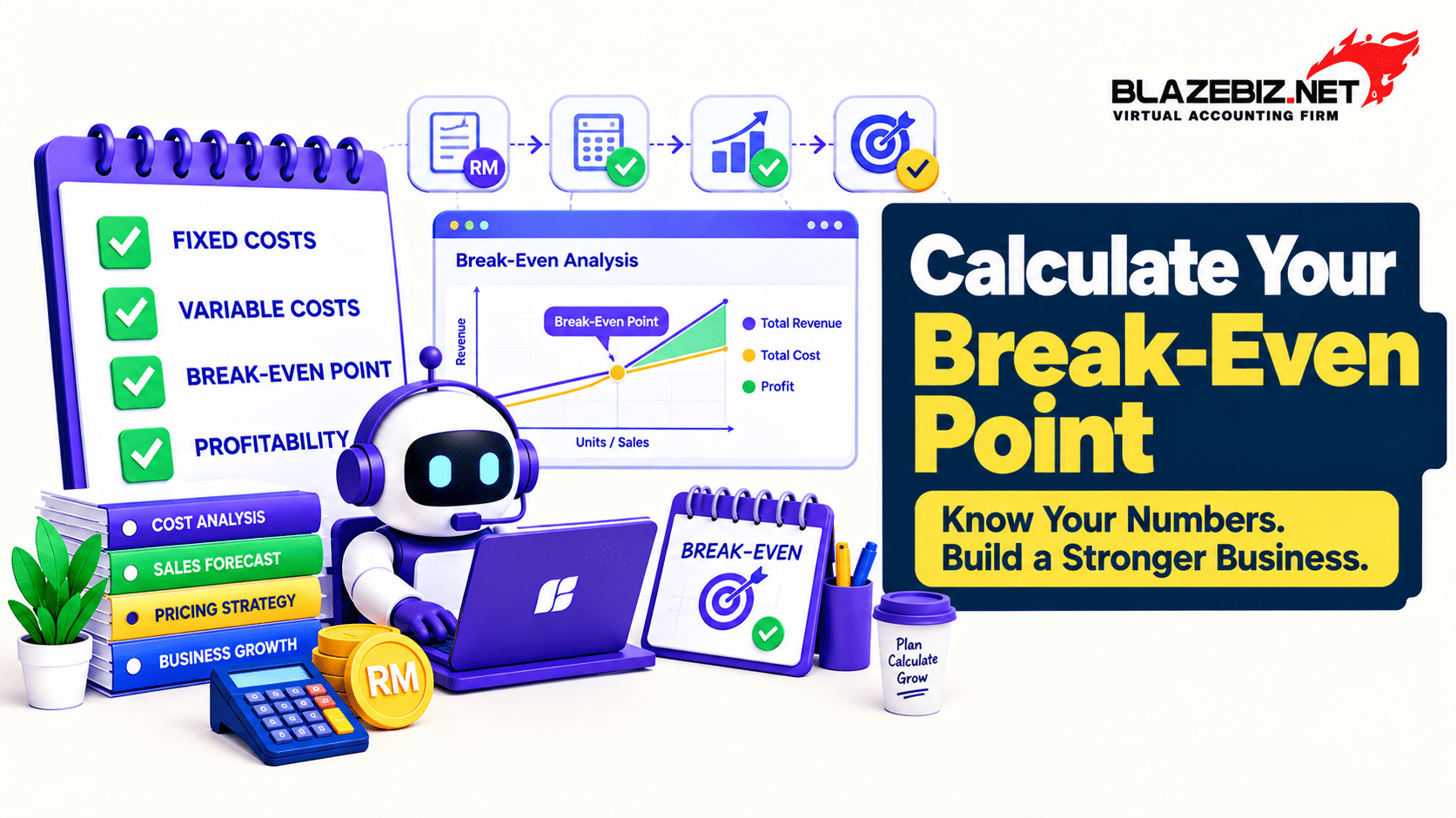
How much does your business need to sell each month to cover its expenses? For Malaysian small and medium-sized enterprises (SMEs), understanding the break-even point can help with pricing decisions, financial planning and profitability.
Break-even analysis helps business owners determine the minimum sales volume or revenue required to cover their costs. Once you know this figure, you can set more realistic sales targets and understand how changes in costs or selling prices affect your business.
What Is a Break-Even Point?
The break-even point is the level of sales at which total revenue equals total costs. At this point, the business makes neither a profit nor a loss, based on the assumptions used in the calculation.
For example, if your business spends RM10,000 a month on fixed costs, your sales must generate enough contribution to cover those costs before you can make an operating profit.
Break-even analysis is useful for retailers, wholesalers, manufacturers, service providers and other businesses that need to understand their minimum sales requirements.
Why Is Break-Even Analysis Important for SMEs?
Knowing your break-even point gives you a clearer picture of how much your business needs to sell to cover its costs. It can help you:
- Set realistic monthly and annual sales targets.
- Evaluate whether your selling prices are sufficient to cover costs.
- Identify opportunities to reduce unnecessary expenses.
- Estimate the sales volume needed before expanding your business.
- Understand the financial impact of increasing rent, salaries or supplier costs.
- Make better-informed budgeting and investment decisions.
Understanding Fixed Costs and Variable Costs
Before calculating your break-even point, separate your business costs into fixed and variable costs. Accurate classification is essential for obtaining a useful result.
Fixed Costs
Fixed costs generally remain stable within a normal operating range, even when sales volume changes. Common examples include:
- Office or shop rent.
- Fixed monthly salaries.
- Insurance and software subscriptions.
- Accounting and administrative expenses.
- Other recurring operating costs that do not vary directly with sales.
Variable Costs
Variable costs change according to the number of products sold or services delivered. Examples include:
- Product purchase costs or raw materials.
- Packaging and delivery costs per order.
- Sales commissions.
- Transaction fees that vary with sales.
- Production materials used for each unit.
Some expenses contain both fixed and variable elements. Where relevant, estimate these components separately so your calculation reflects how the costs behave as sales change.
Break-Even Point Formula
There are two common ways to calculate your break-even point: the number of units you need to sell and the total sales revenue required to cover your costs.
1. Break-Even Point in Units
Break-even units = Fixed costs ÷ Contribution margin per unit
First, calculate your contribution margin per unit:
Contribution margin per unit = Selling price per unit − Variable cost per unit
The contribution margin is the amount remaining from each sale after deducting its variable cost. This amount contributes towards covering fixed costs. After fixed costs are covered, additional contribution can generate operating profit.
2. Break-Even Point in Sales Revenue
Break-even sales revenue = Fixed costs ÷ Contribution margin ratio
Calculate the contribution margin ratio using this formula:
Contribution margin ratio = Contribution margin per unit ÷ Selling price per unit
Multiply the ratio by 100 to express it as a percentage. This method is useful when you want to know how much revenue your business must generate rather than how many units it must sell.
How to Calculate the Break-Even Point: A Practical Example
Consider a Malaysian SME selling a product for RM50 per unit. The business has monthly fixed costs of RM10,000 and a variable cost of RM30 for each unit sold.
| Item | Amount |
|---|---|
| Monthly fixed costs | RM10,000 |
| Selling price per unit | RM50 |
| Variable cost per unit | RM30 |
| Contribution margin per unit | RM20 |
Step 1: Calculate the Contribution Margin
Selling price − Variable cost = Contribution margin
RM50 − RM30 = RM20 per unit
Step 2: Calculate the Break-Even Units
Fixed costs ÷ Contribution margin per unit = Break-even units
RM10,000 ÷ RM20 = 500 units
Step 3: Calculate the Break-Even Sales Revenue
Break-even units × Selling price per unit = Break-even sales
500 × RM50 = RM25,000
Result: The business needs to sell 500 units and generate RM25,000 in monthly revenue to break even. Selling more than 500 units can generate an operating profit, provided the selling price, variable cost per unit and fixed costs remain unchanged.
What Happens When Your Costs or Selling Prices Change?
Your break-even point is affected by changes in selling prices, variable costs and fixed expenses. Understanding these changes helps you assess your business’s financial position.
- Higher fixed costs: Increase the sales contribution required to cover expenses.
- Higher variable costs: Reduce the contribution earned from each unit sold.
- Higher selling prices: Can lower the break-even quantity if costs and customer demand remain unchanged.
- Lower selling prices: May require higher sales volumes to cover the same fixed costs.
- Lower operating expenses: Can reduce the sales needed to break even.
Before increasing prices or cutting expenses, consider customer demand, competition, service quality and the impact on long-term business performance.
What Is the Margin of Safety?
The margin of safety shows how far your actual or expected sales are above the break-even level. It helps you understand how much sales can fall before the business reaches its break-even point.
Margin of safety = Actual sales − Break-even sales
For example, if monthly sales are RM35,000 and break-even sales are RM25,000, the margin of safety is RM10,000. This means sales could decline by RM10,000 before reaching the break-even level, assuming the underlying costs and selling prices remain unchanged.
Common Break-Even Calculation Mistakes to Avoid
- Leaving out expenses: Missing costs can make the break-even target appear lower than it really is.
- Mixing time periods: Ensure fixed costs and sales figures cover the same period.
- Using unrealistic selling prices: Account for typical discounts and sales commissions where relevant.
- Confusing sales with profit: High revenue does not guarantee profitability when costs are also high.
- Ignoring cost increases: Supplier price changes and higher rent can affect your break-even point.
- Overlooking different product margins: Businesses selling several products should consider their different contribution margins and sales mix.
How Accounting Software Helps With Break-Even Analysis
Break-even calculations depend on accurate sales and cost information. Incomplete records or incorrectly classified expenses can lead to misleading results.
Accounting software can help organise sales, purchases, expenses, inventory and financial reports. These records provide a useful starting point for reviewing costs, calculating contribution margins and monitoring profitability.
SQL Accounting from BlazeBiz helps businesses manage accounting records and generate financial reports. Reliable financial information can support break-even analysis, budgeting and business planning.
For more practical guidance, read our articles on inventory management in Malaysia and preparing accurate financial reports faster.
Frequently Asked Questions
What is the break-even point formula?
Break-even units are calculated by dividing total fixed costs by the contribution margin per unit. Break-even sales revenue is calculated by dividing fixed costs by the contribution margin ratio.
Can a small business calculate its break-even point?
Yes. A small business can calculate its break-even point using fixed costs, variable costs and selling prices. The figures should be accurate and cover the same period.
Is the break-even point the same as making a profit?
No. At the break-even point, total revenue equals total costs, so there is no profit or loss under the calculation assumptions. Profit begins when revenue exceeds total costs.
How often should I calculate my break-even point?
Review it whenever significant costs or selling prices change. A monthly review can also help you assess whether your sales targets remain realistic.
Can service businesses use break-even analysis?
Yes. Service businesses can calculate their break-even point using fees per job or project and the variable costs associated with delivering the service. They should also include relevant fixed operating costs.
Final Thoughts
Understanding your break-even point helps you set practical sales targets, evaluate pricing and determine how much revenue your business needs to cover its costs. Start with accurate financial records, calculate your contribution margin and review the figures whenever your business costs or selling prices change.
Looking to improve your accounting and financial reporting processes? Visit BlazeBiz to explore accounting solutions for your business.
