
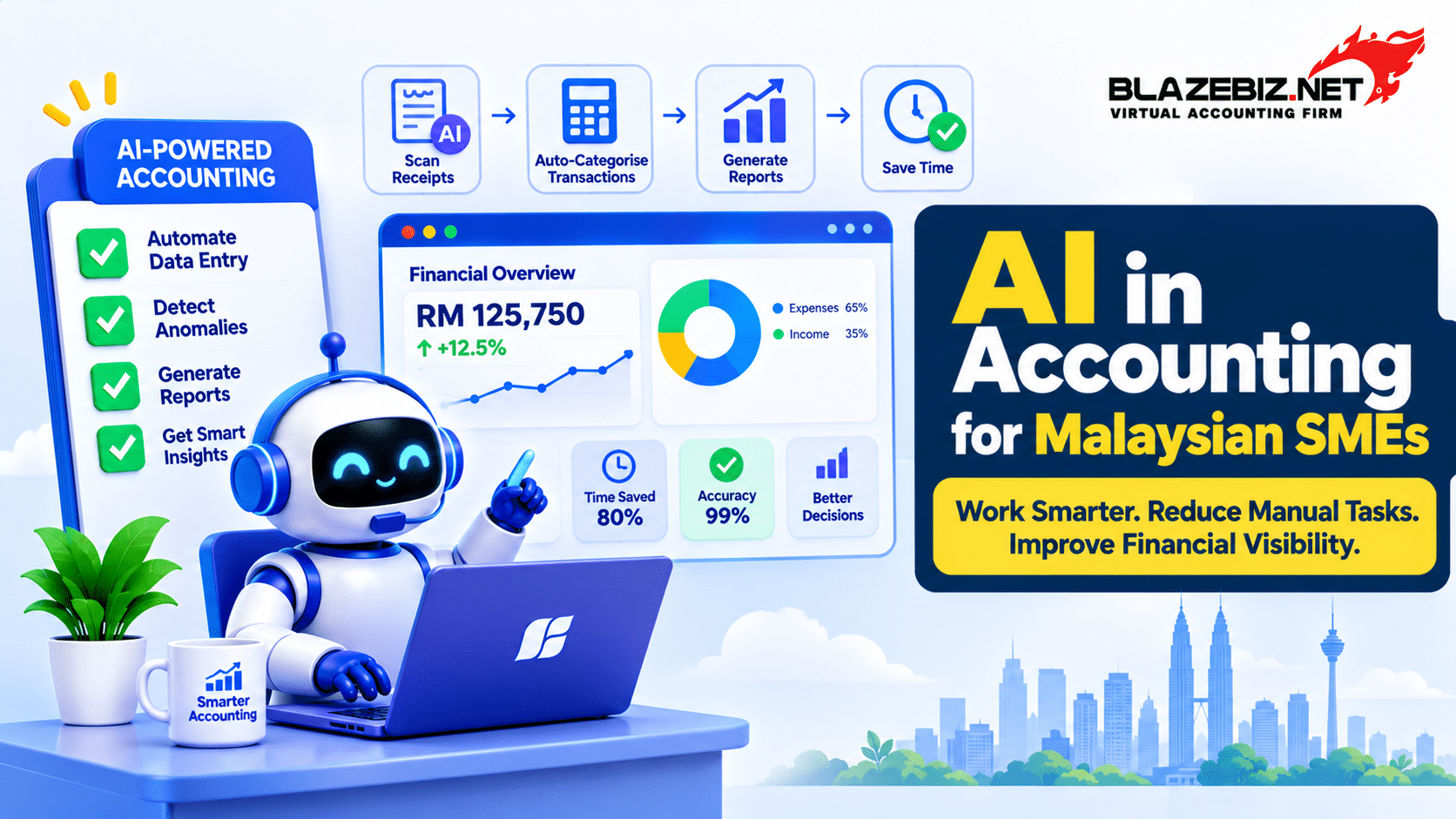
Artificial intelligence (AI) is changing how businesses manage everyday operations, including accounting and financial administration. Tasks that once required hours of manual data entry, document checking and spreadsheet analysis can now be supported by intelligent digital tools.
For Malaysian small and medium-sized enterprises (SMEs), AI in accounting offers opportunities to improve productivity, organise financial information and reduce repetitive administrative work. From processing invoices to analysing business expenses, AI-powered tools are becoming increasingly relevant to modern finance teams.
However, adopting AI does not mean removing accountants or allowing software to make every financial decision. The real value comes from combining automation with proper accounting knowledge, accurate records and human review.
In this guide, we explore seven practical ways Malaysian SMEs can use AI in accounting, the benefits and limitations, and how businesses can prepare for a more digital accounting environment.
What Is AI in Accounting?
AI in accounting refers to the use of artificial intelligence technologies to support financial and accounting activities. These technologies can analyse information, recognise patterns, extract data from documents and assist with repetitive processes.
Depending on the tools being used, AI applications in accounting may include:
- Extracting information from invoices and receipts.
- Suggesting accounting categories for transactions.
- Identifying unusual expenses and transaction patterns.
- Assisting with bank transaction matching.
- Summarising financial reports.
- Supporting cash flow analysis.
- Answering questions about financial information.
AI can help accountants process information more efficiently, but the accuracy of its output depends on the quality of the source data, system configuration and appropriate review.
Why AI Is Becoming Important for Malaysian SMEs
Many SMEs still depend on spreadsheets, manual bookkeeping and disconnected business applications. As transaction volumes increase, maintaining accurate financial records can become more challenging.
AI and digital accounting tools can help reduce repetitive administrative work and improve access to financial information.
Malaysia’s digitalisation landscape is also evolving. Visa’s 2025 MSME research highlighted productivity, stronger financial management, cybersecurity and cash flow improvement as important digital adoption priorities. UOB’s 2026 business outlook also identified growing interest in AI adoption, while noting that smaller businesses face implementation and skills challenges. These findings show why practical, affordable digital solutions matter to SMEs.
7 Ways AI Can Improve Accounting for Malaysian SMEs
1. Automating Invoice and Receipt Processing
Invoice and receipt processing is one of the repetitive tasks that can benefit from AI-powered document recognition.
AI-based document processing tools can extract information such as supplier names, invoice numbers, dates, descriptions and amounts from supported documents.
For example, a business receiving multiple supplier invoices every week may use document recognition to capture relevant information and prepare it for checking before it is entered into the accounting system.
Potential benefits include:
- Less repetitive manual data entry.
- Faster document processing.
- More organised invoice records.
- Reduced risk of common typing mistakes.
- Quicker identification of missing information.
However, extracted information should still be checked against the original document, especially for tax details, invoice totals and supplier information.
2. Improving Expense Tracking and Categorisation
Businesses make many different types of payments throughout the month. These may include office supplies, transportation, utilities, marketing, subscriptions and supplier expenses.
AI tools can analyse transaction descriptions and suggest possible expense categories based on previous records and predefined rules.
For example, a transaction containing a familiar office supplier name may be suggested for stationery or office supplies, depending on the business’s accounting setup.
This can help finance teams organise expenses and identify transactions that need further checking.
AI suggestions should not automatically be treated as confirmed accounting entries. Employees should review unusual transactions and ensure that expenses are classified correctly.
3. Supporting Bank Reconciliation
Bank reconciliation involves comparing transactions recorded in the accounting system with the transactions appearing on bank statements.
AI-assisted matching tools can help identify transactions using information such as amounts, dates, descriptions and payment references. This can reduce the time spent manually comparing individual entries.
For example, a business may receive several customer payments with similar descriptions. A matching tool can help identify potential corresponding entries and highlight transactions that require further investigation.
Finance staff should still investigate unmatched transactions, duplicate entries and differences before completing reconciliation.
For a practical explanation, read our guide to bank reconciliation in Malaysia.
4. Generating Financial Reports Faster
Financial reports help business owners understand how their companies are performing. However, analysing different reports and identifying important changes can take time.
AI tools can assist by summarising financial information, identifying patterns and explaining changes in business performance.
For example, an AI assistant may help summarise:
- Monthly revenue movements.
- Changes in operating expenses.
- Differences between budgeted and actual spending.
- Outstanding customer payments.
- Supplier payment obligations.
- Changes in profit margins.
Business owners can use these summaries as a starting point for further analysis. Important financial decisions should still be based on verified accounting records and appropriate professional judgement.
5. Supporting Cash Flow Forecasting
Cash flow management is essential for SMEs because a profitable business can still experience financial pressure when customer payments are delayed or operating expenses increase.
AI tools can analyse historical sales, payment patterns, expenses and outstanding invoices to support cash flow forecasting.
For example, a business may use historical customer payment information to estimate when outstanding invoices are likely to be collected. It can then compare expected collections with upcoming supplier payments, salaries and other operating commitments.
AI-supported forecasting can help business owners identify potential cash shortages earlier and prepare appropriate actions.
However, forecasts are estimates rather than guarantees. Unexpected expenses, delayed payments and changes in customer demand can affect actual cash flow.
Explore our guide to cash flow forecasting for Malaysian SMEs to understand how businesses can plan future cash requirements.
6. Identifying Unusual Transactions and Potential Errors
Unusual transactions can sometimes indicate duplicate payments, incorrect entries, unexpected expenses or other accounting issues.
AI-based analysis can examine transaction patterns and highlight activities that differ from normal business behaviour.
Examples include:
- Repeated payments with similar amounts and references.
- Unexpected increases in particular expense categories.
- Transactions recorded outside normal business patterns.
- Unusual supplier payment activity.
- Significant changes in monthly operating costs.
These alerts can help finance teams decide which transactions require additional review. An unusual transaction is not automatically an error or fraud, so it should be investigated before any conclusion is made.
7. Improving Accounting Analysis and Decision-Making
AI can make financial information easier to understand by helping users explore questions using available business data.
For example, a business owner may want to understand why expenses increased during a particular month or which product categories contribute the most revenue.
With suitable data and tools, AI can help organise the information and provide an initial explanation of the results.
This can support management discussions about:
- Pricing and profitability.
- Operating cost control.
- Inventory purchasing decisions.
- Customer payment performance.
- Business budgeting.
- Future expansion plans.
The quality of these insights depends on accurate source information. AI should support decision-making rather than replace management judgement.
AI Accounting vs Traditional Accounting
Traditional accounting relies heavily on manual processes, predefined software functions and human review. AI-assisted accounting introduces additional tools that can recognise patterns, process documents and support financial analysis.
| Accounting Activity | Traditional Approach | AI-Assisted Approach |
|---|---|---|
| Invoice processing | Manual data entry | Document data extraction and review |
| Expense categorisation | Manual account selection | Suggested categories based on transaction data |
| Bank reconciliation | Manual transaction comparison | Potential transaction matching and exception detection |
| Financial reporting | Manual report interpretation | Automated summaries and analytical assistance |
| Cash flow forecasting | Spreadsheet-based estimates | Data-assisted forecasting and scenario analysis |
| Error detection | Manual checking and review | Pattern analysis and unusual transaction alerts |
AI does not eliminate the need for traditional accounting processes. It adds another layer of assistance that can make certain activities more efficient when implemented correctly.
Challenges of Using AI in Accounting
Although AI offers several potential benefits, Malaysian SMEs should understand its limitations before introducing it into financial operations.
1. Inaccurate or Incomplete Data
AI systems depend on the information they receive. Missing invoices, incorrect transaction descriptions and inconsistent accounting records can affect the quality of their output.
2. Data Security and Confidentiality
Accounting information may contain sensitive business, customer, employee and supplier details. Before using an AI tool, businesses should understand its data handling practices, access permissions, storage arrangements and security controls.
3. Implementation Costs
Some AI tools require subscription fees, system integration, staff training or additional technology investment. SMEs should evaluate the total cost against the actual time savings and business benefits.
4. Staff Training and Adaptation
Employees need to understand how to use AI tools and how to verify their results. Without proper training, staff may either avoid the technology or rely on its suggestions without checking them.
5. Over-Reliance on Automated Results
AI can produce incorrect classifications, misleading summaries or inaccurate calculations. Businesses should maintain approval procedures, transaction verification and human oversight for important financial activities.
How Malaysian SMEs Can Start Using AI in Accounting
Businesses do not need to automate every accounting activity at once. A gradual approach allows SMEs to identify practical opportunities without creating unnecessary disruption.
Step 1: Review Your Existing Accounting Processes
Identify activities that consume the most time. These may include invoice entry, expense recording, transaction matching or monthly report preparation.
Step 2: Identify Repetitive Tasks
Start with tasks that follow consistent procedures and involve structured information. These are generally easier to evaluate for automation than complex financial decisions.
Step 3: Choose Suitable Digital Tools
Compare accounting software and AI applications based on their capabilities, integration options, security arrangements, pricing and suitability for your business.
Step 4: Clean Up Your Financial Records
Ensure that customer records, supplier details, expense categories and transaction information are organised. Reliable data provides a stronger foundation for automation and analysis.
Step 5: Train Your Finance Team
Explain which tasks the AI tool can assist with, which outputs need checking and who is responsible for approving accounting entries and financial reports.
Step 6: Measure the Results
Compare the time spent on tasks before and after introducing the tool. Also review processing errors, outstanding transactions, staff workload and overall implementation costs.
Continue using the tools that provide measurable value and improve the processes that do not deliver the expected results.
AI and E-Invoicing in Malaysia
Malaysia’s e-Invoicing implementation has increased the importance of digital invoicing, accurate transaction information and structured financial records.
AI and e-Invoicing serve different purposes. E-Invoicing is a regulatory and transaction-document process, while AI can assist with tasks such as document extraction, data checking and administrative analysis.
For example, an AI-powered document tool may help extract information from an invoice, but that does not mean the document has been validated or submitted successfully through the Inland Revenue Board of Malaysia’s MyInvois system.
Businesses must still follow the applicable LHDN requirements, use supported submission processes and verify the status of their e-Invoices.
When evaluating accounting software, Malaysian SMEs should check whether it supports their invoicing and e-Invoicing requirements, including the relevant integration and validation workflow.
How SQL Accounting Supports Digital Accounting Workflows
AI adoption should be considered as part of a wider digital accounting strategy. Before introducing additional AI applications, businesses need a reliable system for recording daily transactions and maintaining organised financial information.
SQL Accounting provides accounting functionality that businesses can use to manage financial records, transactions and reporting workflows.
When evaluating SQL Accounting or any other accounting platform, SMEs should consider:
- General ledger and financial transaction management.
- Sales invoicing and customer records.
- Purchase and supplier transaction management.
- Bank reconciliation capabilities.
- Financial reporting and analysis.
- Available e-Invoicing functionality and integration options.
- Compatibility with other business applications.
AI applications can complement an accounting system where suitable integrations and secure workflows are available. However, businesses should confirm which features are native, which require third-party tools and which need additional configuration.
The objective is not simply to adopt more technology. It is to build a connected accounting process that improves efficiency while maintaining accurate and reliable financial records.
Frequently Asked Questions About AI in Accounting
What is AI in accounting?
AI in accounting refers to the use of artificial intelligence to assist with financial tasks such as invoice processing, expense categorisation, transaction analysis, reporting and forecasting. It helps accountants process information more efficiently while maintaining the need for human review.
Can AI replace accountants in Malaysia?
No. AI can automate or assist with certain repetitive accounting activities, but accountants remain important for financial interpretation, compliance, internal controls, professional judgement and business advice.
How can Malaysian SMEs use AI in bookkeeping?
SMEs can use suitable AI tools to extract invoice information, organise expense records, suggest transaction categories, identify unusual entries and support financial analysis. Businesses should review the accuracy of automated outputs before updating accounting records.
Is AI accounting software expensive?
Costs vary depending on the software, features, number of users, integrations and level of automation. SMEs should compare subscription and implementation costs with the expected time savings and operational benefits.
Is AI safe for handling financial information?
AI can be used in accounting workflows when appropriate security and privacy controls are in place. Businesses should assess data storage, access permissions, confidentiality, provider policies and applicable Malaysian data protection requirements before sharing sensitive financial information.
Can AI help with bank reconciliation?
Yes. Suitable AI-assisted tools can help identify potential transaction matches and highlight unusual or unmatched entries. The final reconciliation should still be reviewed to ensure that differences are properly explained and recorded.
Does SQL Accounting include AI features?
Available features depend on the SQL Accounting version, modules and integrations. Businesses should confirm directly with their software provider which AI capabilities are included, which require third-party applications and what integration options are available.
Final Thoughts
AI is creating new opportunities for Malaysian SMEs to improve accounting efficiency, reduce repetitive administrative work and understand financial information more effectively.
From invoice processing and expense tracking to bank reconciliation and cash flow analysis, AI can support many accounting activities. However, accurate records, proper controls and human verification remain essential.
For SMEs, the best starting point is to identify repetitive accounting tasks, improve existing financial records and select digital tools that provide practical business value.
BlazeBiz helps Malaysian businesses streamline their accounting and business processes with solutions such as SQL Accounting and SQL Payroll.
Visit BlazeBiz to explore accounting solutions that can help your business move towards a more organised and efficient digital workflow.
