
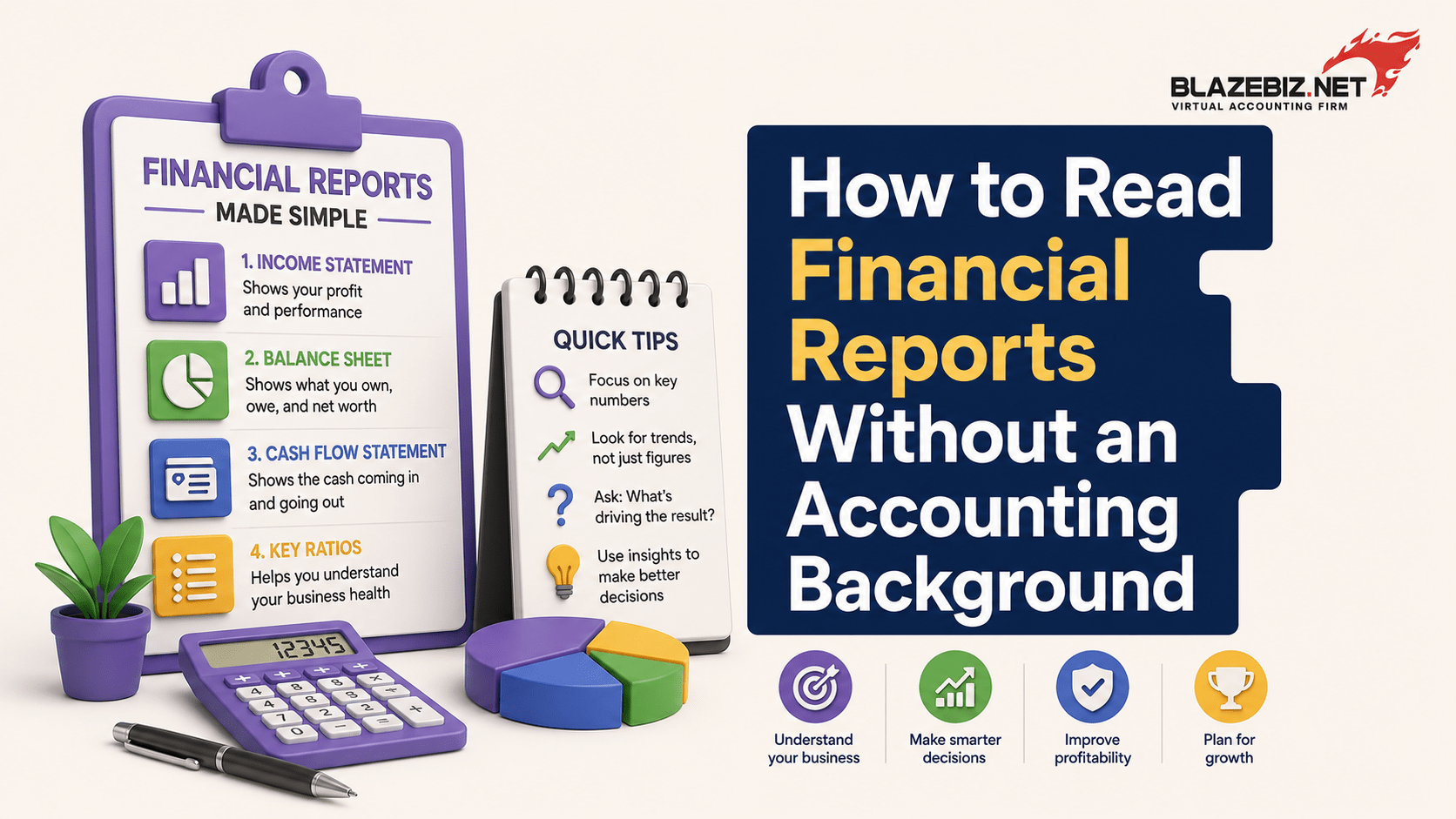
Financial reports are often seen as documents meant only for accountants. In reality, every business owner and manager should understand the basics of their financial reports. These reports provide valuable insights into how a business is performing, where money is being spent, and whether the business is on track to achieve its goals.
The good news is that you don’t need an accounting background to understand the key numbers. By learning a few essential reports and what they represent, you can make more informed business decisions with confidence.
Quick Answer
The three most important financial reports are the Profit and Loss Statement, Balance Sheet, and Cash Flow Statement. Understanding what each report shows can help business owners monitor profitability, manage cash flow, and evaluate the overall financial health of their business.
Key Takeaways
- Financial reports help you understand your business performance.
- You don’t need to be an accountant to read the basics.
- Focus on profitability, cash flow, and financial position.
- Reviewing reports regularly supports better decision-making.
- Modern accounting software makes financial reporting easier and more accurate.
Why Financial Reports Matter
Whether you run a retail store, a manufacturing company, or a service business, financial reports answer important questions such as:
- Is the business making a profit?
- Do we have enough cash to pay our expenses?
- Are sales increasing or decreasing?
- Which expenses are growing the fastest?
- Can we afford to invest in new equipment or hire more employees?
Instead of relying on assumptions, financial reports provide facts that help guide business decisions.
1. Profit and Loss Statement (Income Statement)
The Profit and Loss (P&L) Statement shows how much your business earned and how much it spent over a specific period.
The key sections include:
Revenue – The total income generated from sales.
Cost of Sales – The direct costs of producing or purchasing your products or services.
Gross Profit– The amount remaining after deducting the cost of sales from revenue.
Operating Expenses – Day-to-day business expenses such as salaries, rent, utilities, marketing, and office costs.
Net Profit – The amount left after all expenses have been deducted.
Questions to Ask
- Is revenue increasing?
- Are expenses growing faster than sales?
- Is the business consistently profitable?
2. Balance Sheet
The Balance Sheet provides a snapshot of your business’s financial position at a specific point in time.
It consists of three main sections:
Assets
Things the business owns, such as:
- Cash
- Inventory
- Equipment
- Accounts Receivable
Liabilities
Money the business owes, including:
- Supplier payments
- Bank loans
- Taxes payable
Equity
The value remaining after liabilities are deducted from assets. This represents the owner’s investment in the business.
Questions to Ask
- Does the business have enough assets to cover its liabilities?
- Is debt increasing over time?
- Is the company’s financial position improving?
—
3. Cash Flow Statement
A profitable business can still experience cash flow problems.
The Cash Flow Statement tracks how money moves in and out of the business.
It shows:
- Cash received from customers
- Cash paid to suppliers
- Operating expenses
- Loan repayments
- Investments
Questions to Ask
- Is enough cash coming into the business?
- Can we comfortably pay suppliers and employees?
- Are we relying too heavily on borrowing?
Cash flow is often one of the most important indicators of a business’s financial stability.
Financial Ratios Every Business Owner Should Know
You don’t need to calculate dozens of financial ratios. Start with these simple measures:
Gross Profit Margin
Shows how much profit remains after covering the direct cost of goods or services.
A healthy margin helps cover operating expenses and supports long-term profitability.
Net Profit Margin
Measures how much of each sales dollar becomes profit after all expenses are paid.
Higher margins generally indicate better financial performance.
Current Ratio
Compares current assets with current liabilities to measure the business’s ability to meet short-term obligations.
A ratio above 1 generally indicates that the business can cover its immediate financial commitments.
How Often Should You Review Financial Reports?
Many business owners only look at financial reports during tax season or at the end of the financial year.
A better approach is to review key reports every month. Regular reviews help you identify trends, monitor performance, and address potential issues before they become major problems.
Tips for Understanding Financial Reports
- Compare reports month by month rather than looking at a single period.
- Focus on trends instead of isolated figures.
- Ask questions when numbers change significantly.
- Use dashboards and visual reports where available.
- Work with your accountant to understand complex transactions.
Over time, reviewing financial reports becomes easier and more meaningful.
Frequently Asked Questions
Do I need accounting knowledge to understand financial reports?
No. Understanding the purpose of each report and the key figures is often enough to make informed business decisions.
Which financial report should I review first?
Most business owners begin with the Profit and Loss Statement, followed by the Cash Flow Statement and Balance Sheet.
How often should financial reports be generated?
Monthly reporting is recommended for most businesses, with additional reviews during budgeting or planning periods.
Can accounting software generate financial reports automatically?
Yes. Most modern accounting software can generate reports in real time, reducing manual work and improving accuracy.
Why is cash flow important if my business is profitable?
Profit measures earnings, while cash flow measures available cash. A profitable business can still face financial difficulties if cash inflows are delayed or expenses exceed available funds.
Final Thoughts
Financial reports are more than just accounting documents—they are valuable tools for running a successful business.
By understanding the basics of the Profit and Loss Statement, Balance Sheet, and Cash Flow Statement, business owners can make more informed decisions, identify opportunities for improvement, and respond quickly to financial challenges.
You don’t need to become an accountant. You simply need to understand the story your numbers are telling.
About Blaze Biz
Blaze Biz empowers Malaysian businesses with integrated solutions for accounting, payroll, POS systems, inventory management, e-Invoice readiness, and business automation. We help SMEs simplify operations, improve productivity, and grow with confidence.
