
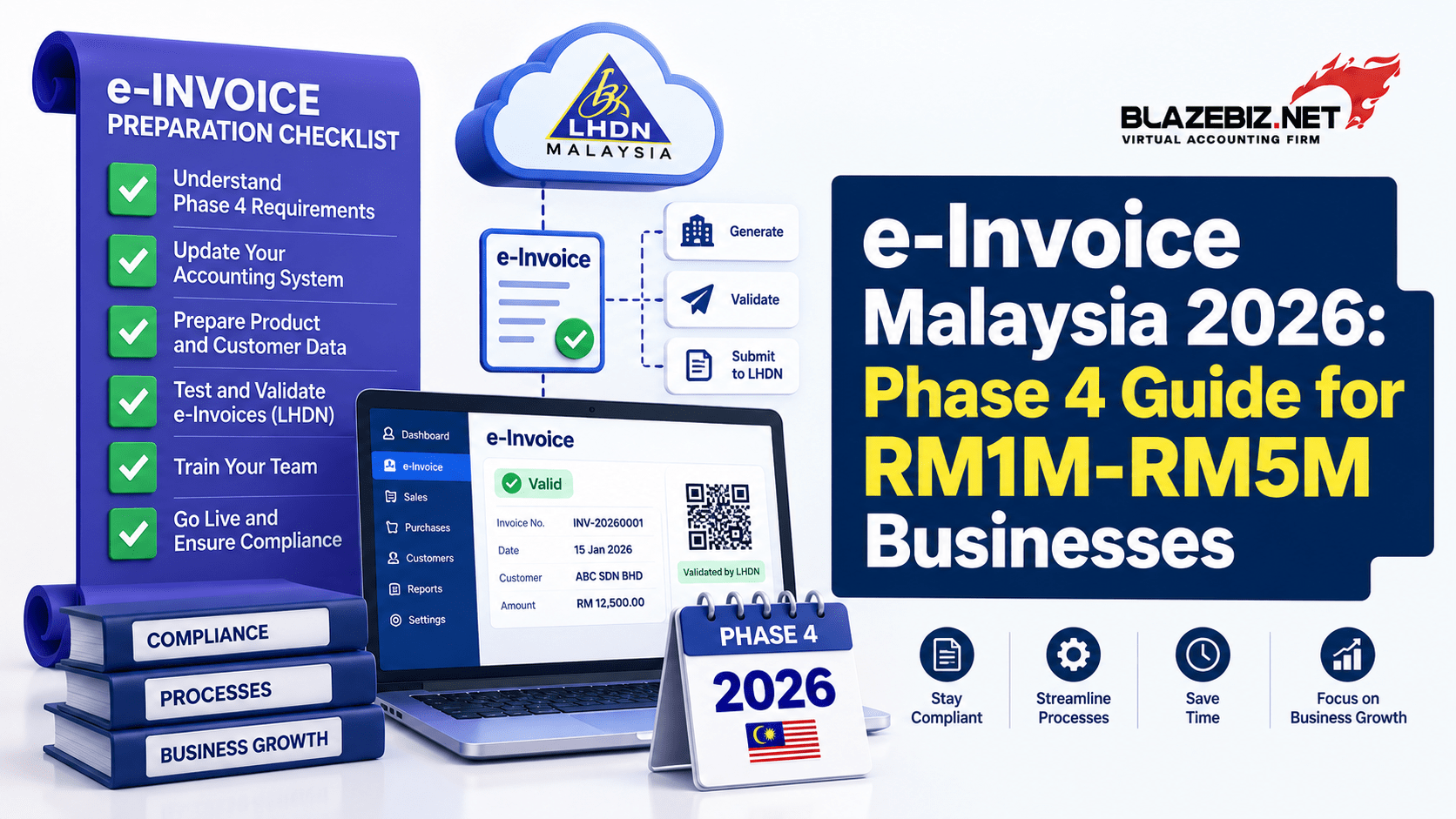
e-Invoice Malaysia 2026: Phase 4 Guide for RM1M–RM5M Businesses
Malaysia’s e-Invoice implementation has moved into a more advanced stage, and businesses need to understand not only when e-Invoice applies, but also how to manage the process efficiently.
For businesses in the RM1 million to RM5 million annual revenue range, e-Invoice preparation involves more than simply replacing paper invoices with digital documents. Businesses need to review their customer and supplier information, invoicing workflow, accounting records and technology setup.
Key Takeaways
- e-Invoice implementation in Malaysia is being rolled out according to taxpayer revenue thresholds.
- Businesses should check the latest HASiL requirements rather than relying on older implementation timelines.
- Accurate customer, supplier and transaction data is important for e-Invoice processing.
- Businesses should review whether their accounting software can support their e-Invoice workflow.
- Automation can reduce repetitive data entry and help minimise invoice errors.
- Businesses should keep monitoring updates from HASiL because e-Invoice guidelines continue to be refined.
What Is e-Invoice in Malaysia?
Malaysia’s e-Invoice system is designed to digitise the way businesses issue and manage invoices. Instead of relying only on conventional invoices exchanged between businesses and customers, transaction information is submitted through the prescribed electronic invoicing framework.
HASiL, the Inland Revenue Board of Malaysia, continues to update its e-Invoice guidance as implementation progresses. The current official reference page lists e-Invoice Guideline Version 4.8 and e-Invoice Specific Guideline Version 4.9.
Businesses should therefore refer to the latest official requirements when planning their e-Invoice processes.
View the latest HASiL e-Invoice Guidelines
Who Does Phase 4 Apply To?
The earlier implementation timeline identified taxpayers with annual turnover or revenue of more than RM1 million and up to RM5 million as Phase 4 taxpayers, with an implementation date of 1 January 2026.
However, businesses should not rely on the old timeline alone. HASiL has subsequently changed the treatment of smaller businesses and continues to update its guidance.
Important: The exact e-Invoice obligation can depend on the taxpayer’s circumstances and applicable exemption criteria. Always check the latest HASiL guidance before deciding whether your business is required to implement e-Invoice.
For the latest official information, refer to the
HASiL e-Invoice portal.
Why Businesses Should Prepare Their e-Invoice Process
e-Invoice affects more than the invoice document itself.
Businesses may need to review how they manage:
- Customer information
- Supplier information
- Business registration details
- Product and service descriptions
- Invoice numbers
- Tax information
- Credit notes and debit notes
- Refunds
- Self-billed transactions
- Accounting records
If these records are incomplete or inconsistent, the transition to a structured e-Invoice process can become more difficult.
1. Review Your Customer and Supplier Data
Accurate master data is one of the foundations of a reliable e-Invoice process.
Review your customer and supplier database and check whether important information is complete and consistent.
This may include:
- Registered business name
- Business registration information
- Tax identification information where applicable
- Contact information
- Address details
- Customer or supplier classification
Cleaning your database before relying heavily on automated e-Invoice processing can reduce unnecessary corrections later.
2. Review Your Current Invoicing Workflow
Before implementing or improving e-Invoice, document how invoices are currently created.
Ask:
- Who creates customer invoices?
- Where is invoice information stored?
- How are invoices sent to customers?
- How are payments recorded?
- How are credit notes handled?
- How are cancelled or corrected invoices managed?
- Which accounting system contains the official transaction record?
This simple review can reveal manual processes that should be improved before introducing additional digital requirements.
3. Make Sure Your Accounting Data Is Accurate
e-Invoice works best when the underlying accounting information is organised.
Businesses should regularly review:
- Sales transactions
- Purchase transactions
- Customer balances
- Supplier balances
- Tax-related information
- Product and service records
- Payment records
Accurate accounting data can make it easier to maintain consistent information throughout the invoicing process.
Businesses looking to centralise their accounting can explore
BlazeBiz SQL Accounting.
4. Choose the Right e-Invoice Workflow
Businesses generally need to consider how e-Invoice information will move from their accounting or invoicing system into the required submission process.
For some businesses, a portal-based approach may be sufficient. Businesses with higher transaction volumes may benefit from a more integrated software workflow.
The right approach depends on:
- Number of monthly invoices
- Number of customers
- Number of branches
- Accounting system currently used
- Transaction complexity
- Internal finance resources
- Required level of automation
5. Avoid Relying Entirely on Manual Data Entry
Manual invoice preparation can increase the risk of entering incorrect customer details, invoice amounts or product information.
As transaction volume increases, these small errors can become difficult to manage.
An accounting system with an appropriate e-Invoice workflow can help businesses reduce repetitive data entry and keep financial records more organised.
This is especially useful for businesses that issue large numbers of invoices every month.
6. Understand Consolidated e-Invoice Requirements
Not every transaction necessarily follows the same invoicing workflow.
Businesses should understand when individual e-Invoices are required and when consolidated e-Invoice treatment may apply under the latest rules.
The treatment can vary depending on the type of transaction and applicable requirements.
Because HASiL continues to refine the rules, businesses should check the latest version of the Specific Guideline before designing their permanent process.
Check the latest e-Invoice Specific Guideline from HASiL
7. Prepare Your Team for e-Invoice
Technology alone does not guarantee a smooth transition.
Employees involved in sales, finance, accounts receivable and invoicing should understand how the new workflow affects their daily responsibilities.
Training should cover:
- Creating invoices correctly
- Checking customer information
- Handling rejected or incorrect transactions
- Processing credit notes and adjustments
- Maintaining customer records
- Following the company’s e-Invoice procedures
A short internal process guide can also help employees follow the same workflow consistently.
8. Keep Monitoring HASiL Updates
One of the biggest mistakes businesses can make is treating e-Invoice as a one-time implementation project.
HASiL has continued to publish updates, revised guidelines and additional explanations as the system develops.
For example, HASiL’s official guidance page was updated in September 2026 with newer versions of the e-Invoice guidelines.
Businesses should therefore establish a process for checking regulatory updates and reviewing whether changes affect their invoicing workflow.
e-Invoice Checklist for Malaysian Businesses
| Area | What to Check |
|---|---|
| Business information | Check registration and taxpayer information. |
| Customer data | Review customer names, addresses and required identification information. |
| Supplier data | Ensure supplier records are complete and consistent. |
| Products & services | Standardise descriptions, pricing and relevant tax information. |
| Accounting system | Check whether your software can support your e-Invoice workflow. |
| Invoice process | Document how invoices are created, submitted and managed. |
| Credit notes | Prepare a clear process for corrections and adjustments. |
| Staff training | Train employees who create or manage invoices. |
| Regulatory updates | Monitor the latest HASiL guidance and announcements. |
How SQL Accounting Can Support Your e-Invoice Workflow
For businesses that already use or are considering accounting software, integrating e-Invoice into the wider accounting workflow can reduce the need to manage information across multiple disconnected systems.
SQL Accounting provides businesses with accounting and financial management functionality that can help centralise sales, purchases, customer and supplier records.
BlazeBiz also provides an
e-Invoice solution for Malaysian businesses
designed to help businesses manage their e-Invoice requirements alongside their accounting processes.
Instead of treating e-Invoice as a completely separate administrative task, businesses can work towards a more connected accounting and invoicing workflow.
Need Help With e-Invoice?
Make your e-Invoice process easier to manage with the right accounting and invoicing setup.
Common e-Invoice Mistakes Businesses Should Avoid
Using Outdated Information
e-Invoice requirements can change as HASiL publishes new guidelines and clarifications. Always check the latest official version before updating your business process.
Keeping Incomplete Customer Records
Incomplete customer information can create unnecessary problems when preparing and processing invoices.
Depending Entirely on Spreadsheets
Spreadsheets may work for simple records, but businesses with a high volume of transactions may find it difficult to maintain consistent information manually.
Ignoring Staff Training
If employees do not understand the new workflow, even a good software system can be used incorrectly.
Treating e-Invoice as Only an Accounting Issue
Sales, finance, purchasing and management may all be affected by changes to invoicing processes. A cross-functional approach can make implementation smoother.
Frequently Asked Questions
What is Phase 4 e-Invoice in Malaysia?
Phase 4 refers to the implementation group historically associated with taxpayers having annual revenue or turnover of more than RM1 million and up to RM5 million, with the original implementation date of 1 January 2026. Businesses should check the latest HASiL requirements and exemption criteria because the rules have since been updated.
Are businesses below RM1 million exempt from e-Invoice?
HASiL has updated the exemption treatment for smaller businesses. The exact eligibility depends on the applicable criteria and taxpayer circumstances, so businesses should check the latest official HASiL guidance rather than relying only on older Phase 5 information.
Do I need accounting software for e-Invoice?
Not every business necessarily needs the same software setup. However, accounting software can make e-Invoice management easier by centralising customer information, transactions and financial records.
Can SQL Accounting support Malaysian businesses with e-Invoice?
SQL Accounting can provide a centralised accounting environment for sales, purchases, customer and supplier records. BlazeBiz also provides e-Invoice solutions designed for Malaysian businesses.
How should a business prepare for e-Invoice?
Start by reviewing your revenue threshold and exemption status, cleaning customer and supplier data, reviewing your invoicing workflow, checking your accounting software and training relevant employees.
Where can I find the latest e-Invoice requirements?
The latest official requirements should be checked directly on the HASiL e-Invoice portal and its published guidelines.
Conclusion
e-Invoice is not simply a change to the format of an invoice. For many businesses, it is an opportunity to improve how customer information, sales transactions and accounting records are managed.
Businesses should start by understanding their current obligations, reviewing their data and improving their invoicing workflow.
Most importantly, keep checking the latest HASiL requirements because Malaysia’s e-Invoice framework continues to evolve.
For businesses looking to combine accounting and e-Invoice processes, BlazeBiz SQL Accounting can provide a centralised accounting platform, while BlazeBiz’s e-Invoice solution can help businesses manage their digital invoicing requirements.
Ready to Simplify Your e-Invoice Process?
Talk to BlazeBiz about an accounting and e-Invoice setup that fits your business.
