
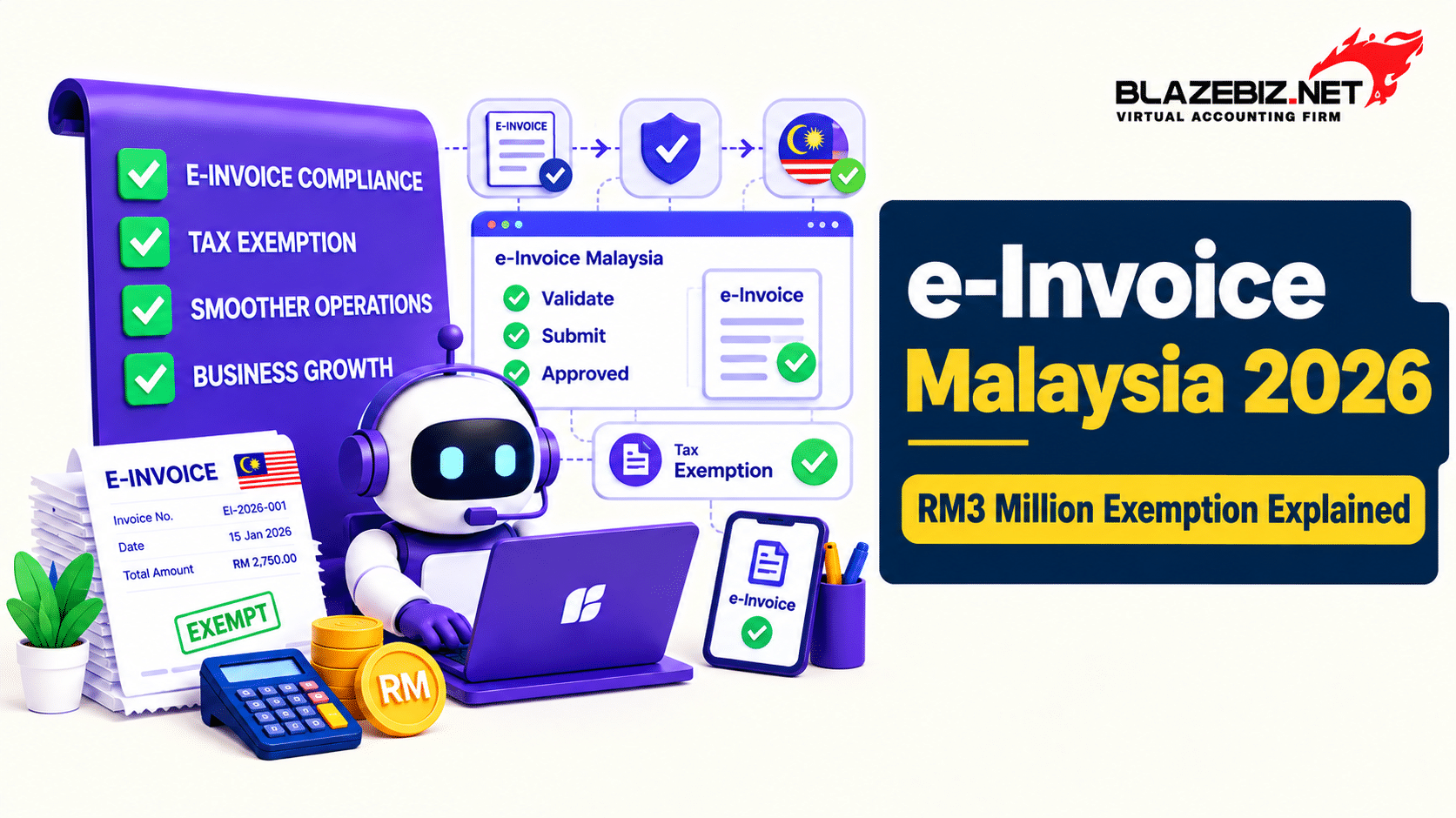
Malaysia's e-Invoice landscape has changed again in 2026, and one of the biggest updates is the increase in the e-Invoice exemption threshold.
Businesses with annual turnover or revenue of less than RM3 million are now exempt from e-Invoice implementation, based on the updated implementation timeline announced by HASiL on 30 August 2026.
This change is particularly important for Malaysian SMEs that were previously preparing to implement e-Invoice based on the earlier threshold.
But exemption does not mean businesses should ignore e-Invoice completely. Growing businesses should still understand the rules, monitor their turnover and prepare their accounting processes for future requirements.
What Is the New RM3 Million e-Invoice Exemption?
Under the updated e-Invoice implementation timeline, taxpayers with annual turnover or revenue of less than RM3 million are exempt from implementing e-Invoice.
This means a business with annual turnover below RM3 million may not need to issue e-Invoices simply because of its current revenue level, subject to the applicable exemption criteria.
However, businesses should not assume that turnover is the only factor that determines their obligation. Certain business structures and related-company conditions may also need to be considered.
What Changed in Malaysia's e-Invoice Rules?
The previous implementation framework covered taxpayers with annual turnover or revenue up to RM5 million from 1 January 2026.
Following the August 2026 update, businesses with annual turnover or revenue below RM3 million are exempt.
| Annual Turnover / Revenue | e-Invoice Position |
|---|---|
| More than RM100 million | Implementation from 1 August 2024 |
| More than RM25 million up to RM100 million | Implementation from 1 January 2025 |
| More than RM5 million up to RM25 million | Implementation from 1 July 2025 |
| RM3 million up to RM5 million | Generally within the 2026 implementation group |
| Less than RM3 million | Exempt, subject to applicable criteria |
Businesses should always check the latest HASiL guidance before making compliance decisions because implementation requirements can depend on the taxpayer's specific circumstances.
Who Benefits Most from the RM3 Million Exemption?
The updated threshold can provide additional relief for many smaller Malaysian businesses that were concerned about the cost and administrative work involved in implementing e-Invoice.
- Small retailers
- Professional service businesses
- Small wholesalers and distributors
- Small contractors
- Family-owned businesses
- Micro and small trading businesses
- Small restaurants and food businesses
- Newer businesses with lower annual revenue
For these businesses, the exemption may reduce the immediate need to change their invoicing workflow solely because of the e-Invoice requirement.
Does Every Business Below RM3 Million Automatically Get an Exemption?
Not necessarily.
Businesses should review the complete HASiL exemption criteria instead of looking only at their own annual turnover.
For example, the rules can consider certain relationships involving companies, subsidiaries, related companies or joint ventures when determining whether an exemption applies.
Therefore, a business owner should check the latest official guidance if the business is part of a larger corporate structure.
What Should SMEs Do If They Are Exempt?
Being exempt from e-Invoice does not mean an SME should stop improving its accounting and invoicing processes.
A growing business can cross the RM3 million threshold in the future. Preparing early can make the eventual transition much easier.
SMEs can use this time to:
- Keep accurate sales and revenue records.
- Maintain organised customer and supplier information.
- Review the current invoicing process.
- Keep accounting records updated regularly.
- Use accounting software instead of relying heavily on spreadsheets.
- Review whether the accounting system supports e-Invoice requirements.
- Monitor annual turnover and revenue.
- Review the latest HASiL requirements periodically.
Why Accounting Software Still Matters for Exempt SMEs
An e-Invoice exemption does not remove the need for accurate accounting.
Businesses still need to track sales, purchases, expenses, customer payments, supplier payments, inventory and financial performance.
Using accounting software can help businesses maintain organised records and reduce the amount of manual work involved in managing transactions.
For example, SQL Accounting provides functions for general ledger, customer management, supplier management, sales, purchases, inventory and financial reporting.
Businesses can therefore build a stronger accounting workflow today while remaining prepared for future compliance requirements.
What About Businesses Between RM3 Million and RM5 Million?
This is an important group to understand.
The updated exemption applies to businesses with annual turnover or revenue of less than RM3 million. Therefore, businesses with turnover between RM3 million and RM5 million should not assume that the new exemption applies to them.
These businesses should review their e-Invoice implementation position and ensure their accounting and invoicing systems are ready for the applicable requirements.
How e-Invoice Can Affect Business Operations
For businesses that are required to implement e-Invoice, the change is not simply about replacing a PDF invoice with a digital invoice.
Businesses may need to review how customer information, supplier information, invoices, credit notes, debit notes and accounting records are handled.
- Customer data: Business information needs to be maintained accurately.
- Invoice information: Required transaction details must be captured correctly.
- Accounting software: The system should support the relevant e-Invoice workflow.
- Internal processes: Finance and administrative teams may need updated procedures.
- Record keeping: Businesses need organised transaction records for financial management and compliance.
Should SMEs Upgrade Their Accounting Software Now?
If your business is currently using spreadsheets or an outdated accounting system, this can be a good time to review your options.
The decision should not be based only on whether your business currently needs e-Invoice.
Instead, consider whether the system can support your business as it grows.
- Sales and purchase management
- Customer and supplier records
- Inventory management
- Accounts receivable and payable
- Financial reporting
- Bank integration where required
- e-Invoice readiness
- Multi-user access
- Multiple branches or entities where required
A scalable accounting system can reduce the need to replace your software every time your business reaches a new stage of growth.
e-Invoice Malaysia 2026: Quick Checklist for SMEs
Use this simple checklist to review your current position:
- Check your latest annual turnover or revenue.
- Confirm whether your business falls below the RM3 million exemption threshold.
- Review whether your business structure meets the applicable exemption criteria.
- Check the latest HASiL implementation guidance.
- Review your current accounting and invoicing software.
- Keep customer and supplier information accurate.
- Monitor your turnover as the business grows.
- Plan ahead if your business is approaching the RM3 million threshold.
Frequently Asked Questions
What is the new e-Invoice exemption threshold in Malaysia?
Businesses with annual turnover or revenue of less than RM3 million are exempt from e-Invoice implementation under the updated HASiL timeline, subject to the applicable exemption criteria.
When was the RM3 million e-Invoice threshold announced?
HASiL announced the increase in the e-Invoice exemption threshold on 30 August 2026.
Is a business with RM2 million annual revenue exempt from e-Invoice?
A business with annual turnover or revenue of RM2 million may fall within the exemption threshold, subject to meeting the applicable HASiL exemption criteria.
Does a business with RM4 million turnover need e-Invoice?
The RM3 million exemption does not cover businesses with RM4 million annual turnover or revenue. Businesses in this range should review the applicable e-Invoice implementation requirements.
Should an exempt SME still use accounting software?
Yes. Accounting software can help SMEs manage sales, purchases, expenses, customers, suppliers, inventory and financial reports even when the business is exempt from e-Invoice.
Can an exempt business voluntarily prepare for e-Invoice?
Businesses can review and improve their accounting and invoicing processes in advance. Voluntary participation and the specific rules applicable to a business should be checked against the latest HASiL guidance.
Prepare Today, Stay Ready for Tomorrow
The increase of the e-Invoice exemption threshold to RM3 million gives many Malaysian SMEs additional breathing room.
However, businesses should not treat the exemption as a reason to ignore accounting digitalisation. As a business grows, accurate financial records, organised customer data and efficient invoicing become increasingly important.
The best approach is to understand your current e-Invoice position, monitor your revenue and build an accounting workflow that can support your business as it grows.
Explore SQL Accounting with BlazeBiz to see how integrated accounting software can help your business manage daily financial operations more efficiently.
