
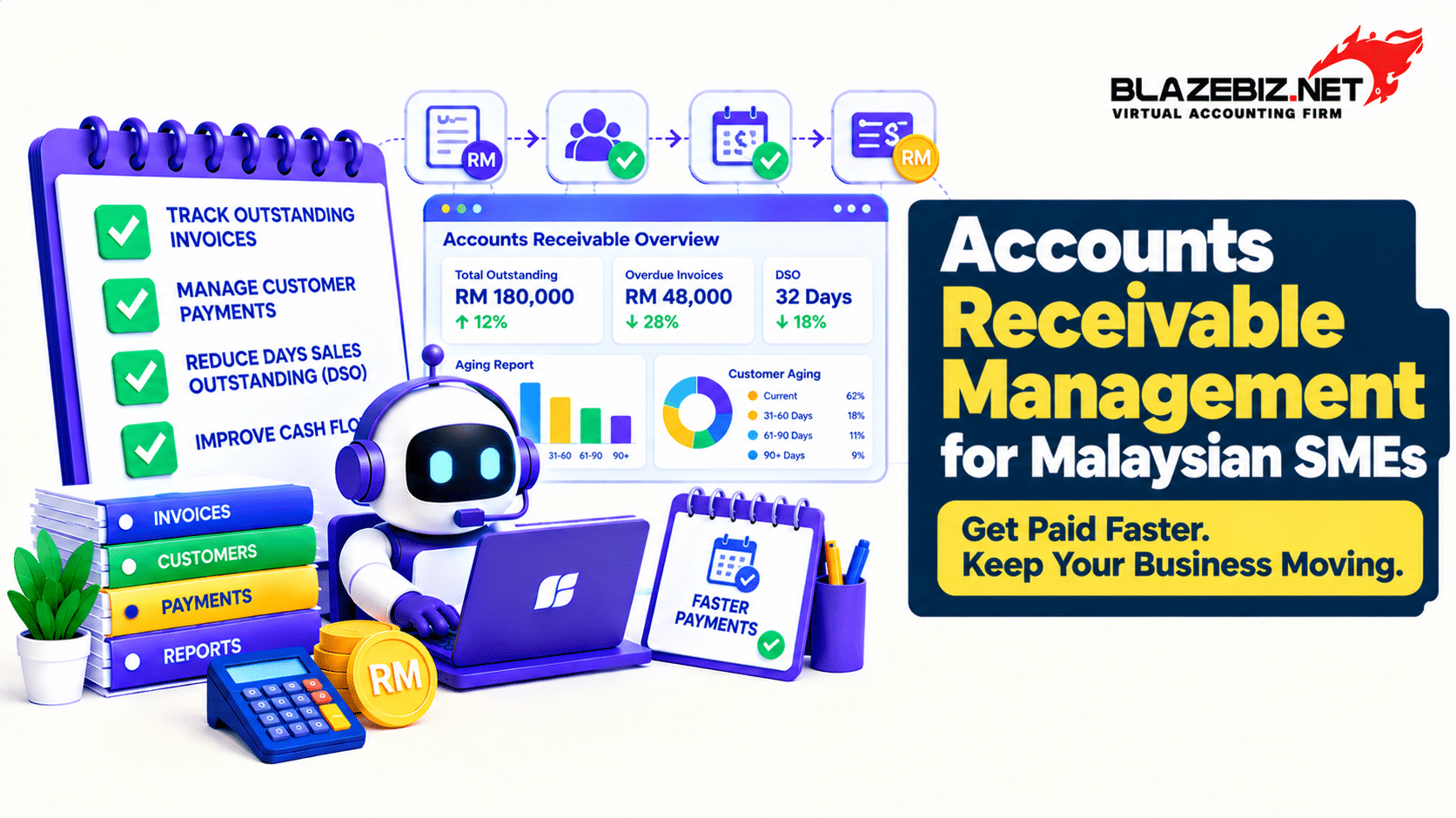
Selling products or services is an important part of growing a business, but making sales does not always mean receiving payment immediately. When customers buy on credit, the business must track the amounts owed and follow up until payment is received.
For Malaysian small and medium-sized enterprises (SMEs), delayed customer payments can create pressure on cash flow, making it harder to pay suppliers, salaries, rent and other operating expenses on time. Without a clear collection process, overdue invoices can accumulate and become more difficult to recover.
Effective accounts receivable management helps businesses monitor customer balances, apply consistent credit terms, follow up on overdue invoices and make better-informed financial decisions. This guide explains how Malaysian SMEs can strengthen their receivables process and improve payment collection.
What Is Accounts Receivable?
Accounts receivable refers to money customers owe a business for products or services already supplied on credit. These amounts are generally recorded as current assets when they are expected to be collected within the applicable short-term period.
For example, a Malaysian wholesaler supplies RM8,000 worth of goods to a customer and issues an invoice with 30-day payment terms. Until the customer pays, the RM8,000 remains an outstanding receivable, subject to any adjustments such as credit notes, returns or disputes.
Accounts receivable commonly arises when businesses:
- Supply products to customers on credit.
- Complete services and invoice customers for payment later.
- Offer approved credit terms to regular business customers.
- Invoice customers according to agreed project milestones.
Accounts receivable differs from cash sales because the money has not yet been collected. The business needs a reliable process to record the invoice, monitor its due date and confirm that the payment is received and correctly allocated.
Why Accounts Receivable Management Matters for Malaysian SMEs
A business can report strong sales and still experience cash shortages when customers pay late. Money tied up in unpaid invoices cannot be used to settle immediate obligations until it is collected.
A structured receivables process helps SMEs:
- Monitor outstanding customer balances.
- Identify overdue invoices before they accumulate.
- Reduce avoidable delays caused by missing or incorrect invoice details.
- Improve cash flow planning.
- Recognise customers who regularly pay late.
- Reduce the risk of uncollectible debts.
- Maintain clearer records for financial reporting and customer communication.
Consistent follow-up also helps businesses communicate payment expectations professionally. Rather than waiting until an invoice is significantly overdue, the finance team can identify potential issues and resolve them earlier.
Accounts Receivable vs Accounts Payable
Accounts receivable and accounts payable represent different sides of a business’s financial obligations.
| Feature | Accounts receivable | Accounts payable |
|---|---|---|
| Meaning | Money customers owe the business | Money the business owes suppliers or other creditors |
| Typical source | Sales made on credit | Purchases made on credit |
| Financial statement classification | Generally an asset | Generally a liability |
| Main objective | Collect payments on time | Pay obligations according to agreed terms |
| Management focus | Invoices, collections and customer credit risk | Supplier invoices, payment schedules and obligations |
Both functions affect working capital and cash flow. Businesses need to collect customer payments efficiently while managing supplier payments responsibly.
For more information about managing supplier obligations, read our guide to accounts payable management for Malaysian SMEs.
7 Ways to Improve Accounts Receivable Management
1. Set Clear Customer Credit Terms
Unclear payment expectations can lead to disagreements and delays. Before supplying goods or services on credit, communicate the agreed payment period, invoice requirements and process for raising disputes.
Depending on the business and customer relationship, credit terms may include payment within 14, 30 or another agreed number of days. The terms should reflect the business’s cash requirements, customer risk and commercial arrangements.
For customers requesting credit for the first time, consider reviewing their payment history, order size and ability to meet the proposed terms. Establish suitable credit limits and review them when the customer’s circumstances or purchasing patterns change.
Clear terms help both parties understand when payment is due and what steps may follow if an invoice remains unpaid.
2. Issue Accurate Invoices Promptly
Delayed or inaccurate invoices can postpone payment. Customers may be unable to process an invoice if essential details are missing, the amount is incorrect or the supporting documents are incomplete.
Before sending an invoice, check that it includes the information required for the transaction and the customer’s payment process. Depending on the arrangement, this may include:
- Correct customer and business details.
- A clear description of the products or services supplied.
- Invoice date, reference number and amount payable.
- Agreed payment terms and due date.
- Applicable tax details and supporting documentation.
- Payment instructions and a contact for invoice queries.
Where Malaysia’s e-Invoice requirements apply, ensure the invoicing process follows the current requirements relevant to the business and transaction. Review the official guidance from the Inland Revenue Board of Malaysia (LHDN) when checking compliance obligations.
Send invoices as soon as the agreed billing milestone is reached. Prompt and accurate invoicing gives customers more time to process payments within the agreed terms.
3. Monitor Outstanding Invoices Regularly
A business should maintain an up-to-date record of invoices issued, payments received, remaining balances and due dates. Reviewing this information regularly helps staff identify which customers need a reminder or follow-up.
A useful receivables review should show:
- Customer name and outstanding balance.
- Invoice number and invoice date.
- Payment due date and agreed terms.
- Amount overdue, if any.
- Previous reminders and customer responses.
- Disputes, promised payment dates and next actions.
Assign responsibility for following up on outstanding accounts. A clear owner for each collection action reduces the chance of invoices being overlooked.
For a step-by-step approach, read our guide on how to track outstanding customer payments effectively.
4. Use an Accounts Receivable Ageing Report
An accounts receivable ageing report groups unpaid invoices according to how long they have remained outstanding. It helps the business prioritise collection efforts and identify customers whose payment delays require attention.
A report may use categories such as current, 1–30 days overdue, 31–60 days overdue, 61–90 days overdue and more than 90 days overdue. The exact categories can be adjusted to suit the business’s payment terms and collection process.
| Ageing category | Outstanding amount | Suggested action |
|---|---|---|
| Not yet due | RM18,000 | Confirm invoice receipt and monitor due dates |
| 1–30 days overdue | RM8,000 | Send reminders and confirm payment status |
| 31–60 days overdue | RM5,000 | Contact the customer and agree on a clear next step |
| 61–90 days overdue | RM3,000 | Escalate follow-up and review the reason for delay |
| More than 90 days overdue | RM2,000 | Assess recoverability and consider appropriate escalation |
| Total outstanding | RM36,000 | Review and assign collection actions |
In this illustrative example, RM10,000 is overdue by more than 30 days. Management can prioritise those balances while continuing to monitor invoices that are not yet due.
Ageing alone does not determine whether an invoice will be collected. The business should also consider customer communication, disputes, payment history and any other relevant information.
5. Follow Up Before and After Due Dates
Waiting until an invoice is significantly overdue can make collection more difficult. A consistent reminder process helps customers prepare for upcoming payments and gives the business an opportunity to resolve administrative issues early.
A practical collection process may include:
- Before the due date: Confirm that the customer has received the invoice and any required supporting documents.
- On the due date: Send a polite reminder if payment has not been received.
- Shortly after the due date: Contact the customer to confirm payment status and identify any issues.
- When delays continue: Escalate the matter according to the business’s credit policy.
- After payment: Record and allocate the receipt to the correct invoice.
Keep communications professional and factual. If a customer disputes an invoice, investigate the issue promptly rather than sending repeated reminders without addressing the underlying problem.
6. Resolve Payment Disputes Quickly
Some invoices remain unpaid because of genuine disputes rather than an unwillingness to pay. Customers may question quantities supplied, pricing, delivery dates, service quality or missing documentation.
When a dispute arises, record the reason, identify the person responsible for resolving it and agree on a reasonable response timeline. Check the supporting documents and issue a correction or credit note when appropriate.
Once the issue is resolved, confirm the outstanding amount and payment due date with the customer. Tracking disputes separately from ordinary overdue invoices helps management understand why collections are delayed.
7. Review Customer Credit Limits and Payment Patterns
A customer who regularly pays late may create greater financial risk if the business continues to increase its credit exposure without review. Monitoring payment patterns helps management decide whether existing terms remain suitable.
Consider reviewing:
- How often the customer pays after the due date.
- The total outstanding balance compared with the approved credit limit.
- Whether overdue invoices are increasing.
- Whether the customer has unresolved disputes or repeated payment issues.
- Whether changes to payment terms or order approvals are appropriate.
Any decision to change credit terms should be consistent with the customer agreement, business policy and applicable law. A documented review helps the business balance customer relationships with the need to manage collection risk.
Important Accounts Receivable Metrics to Track
Tracking a small number of meaningful metrics helps management evaluate whether the collection process is improving. The right measures depend on the business model, payment terms and customer base.
Days Sales Outstanding (DSO)
Days sales outstanding estimates the average number of days a business takes to collect payment after making credit sales over a chosen period.
Basic DSO formula = Average Accounts Receivable ÷ Net Credit Sales × Number of Days in the Period
For example, if average accounts receivable is RM30,000, net credit sales for a 30-day period are RM60,000, and the figures are measured consistently, DSO is 15 days.
A rising DSO may indicate that customers are taking longer to pay, although changes in sales volume, customer mix and seasonality can also affect the result. Compare DSO over time and interpret it alongside the agreed credit terms.
Overdue Receivables
Overdue receivables show how much customers owe after their agreed payment dates. Review both the total overdue amount and the proportion of receivables that are overdue.
A growing overdue balance may signal that reminders are not being sent consistently, invoice disputes are taking too long to resolve or credit terms need review.
Collection Rate
Businesses can track collections against amounts due during a period to understand whether payment collection is keeping pace with expectations. Define the calculation consistently, including how partial payments, opening balances and disputed invoices are treated.
Use the trend as a management indicator rather than a standalone measure. A high collection rate for newly due invoices may not reveal problems with older overdue balances.
Common Accounts Receivable Mistakes to Avoid
Malaysian SMEs can weaken their collection process when they:
- Delay issuing invoices after completing a sale or service.
- Use unclear payment terms or inconsistent credit policies.
- Fail to monitor overdue invoices regularly.
- Rely on memory instead of a documented follow-up process.
- Ignore customer disputes until the invoice becomes significantly overdue.
- Allow credit exposure to grow without reviewing payment behaviour.
- Fail to allocate received payments to the correct customer invoices.
- Use incomplete records to estimate outstanding balances.
The solution is a consistent process that combines accurate invoicing, clear ownership, regular ageing reviews and prompt communication with customers.
How Accounting Software Supports Accounts Receivable Management
Managing customer invoices through scattered spreadsheets and manual reminders can become difficult as a business grows. Accounting software can help centralise receivables information and make it easier to review outstanding balances.
Depending on the selected software, modules and configuration, useful functions may include:
- Creating and recording customer invoices.
- Maintaining customer account balances.
- Recording receipts and allocating them to invoices.
- Reviewing outstanding and overdue balances.
- Generating receivables ageing reports.
- Checking customer transactions and payment history.
- Supporting financial reporting and reconciliation processes.
Automated reminders or integrations may be available in some systems or through additional tools. Businesses should confirm which functions are supported by their chosen software and configuration.
BlazeBiz provides SQL Accounting solutions for Malaysian businesses. Review the available customer invoicing, receivables reporting and payment-recording features to determine whether they suit your collection workflow.
Frequently Asked Questions
What is accounts receivable management?
Accounts receivable management is the process of recording customer invoices, monitoring outstanding balances, following up on payments and resolving issues that delay collection. It helps businesses manage credit sales and plan cash flow more effectively.
How can Malaysian SMEs reduce overdue invoices?
SMEs can reduce avoidable payment delays by setting clear credit terms, issuing accurate invoices promptly, monitoring ageing reports, sending timely reminders and resolving disputes quickly. Reviewing customer payment patterns also helps businesses manage credit risk.
What is an accounts receivable ageing report?
An accounts receivable ageing report groups outstanding invoices by how long they have remained unpaid. It helps businesses identify overdue balances, prioritise collection efforts and monitor customer payment patterns.
What is days sales outstanding?
Days sales outstanding, or DSO, estimates the average time taken to collect credit sales. It can help businesses monitor collection performance when calculated consistently and reviewed alongside payment terms and changes in sales.
How often should accounts receivable be reviewed?
The review frequency depends on transaction volume, customer payment terms and cash flow needs. Many SMEs benefit from checking overdue invoices weekly and reviewing the full receivables ageing report at least monthly.
Can accounting software help track customer payments?
Accounting software can help record invoices, allocate customer receipts, maintain account balances and generate receivables reports. Available features depend on the selected product, modules and configuration, and accurate records remain essential.
Improve Accounts Receivable Management with BlazeBiz
Effective accounts receivable management helps Malaysian SMEs maintain clearer customer records, identify overdue invoices earlier and make more informed cash flow decisions. The process begins with clear credit terms and accurate invoicing, followed by regular monitoring and professional collection follow-up.
As the business grows, a consistent receivables process can help reduce avoidable delays and provide better visibility into money customers still owe. Reviewing payment patterns also helps management make more informed decisions about customer credit and collection priorities.
BlazeBiz supports Malaysian businesses with accounting solutions designed to organise financial transactions and reporting. Explore SQL Accounting to learn more about the available features for your business.
Track every invoice, follow up consistently and use reliable financial information to build a more disciplined customer payment process.
