
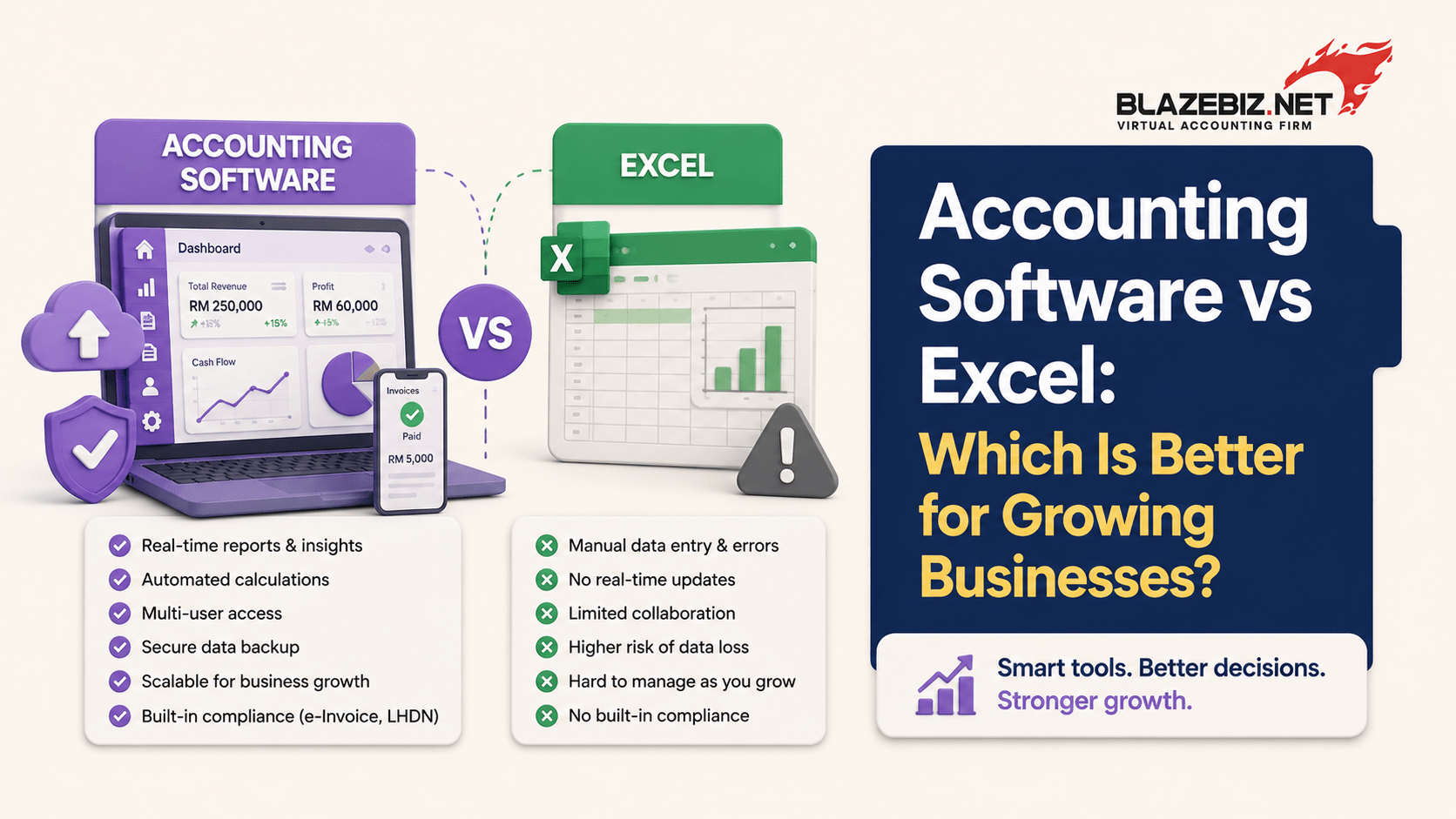
For many businesses, Microsoft Excel is often the first tool used to record income, expenses, and other financial information. It’s familiar, affordable, and works well for simple bookkeeping.
However, as a business grows, managing finances with spreadsheets can become more time-consuming and increase the risk of errors. This is where accounting software offers a significant advantage.
If you’re wondering whether it’s time to move beyond Excel, here’s a comparison to help you make an informed decision.
Quick Answer
Excel is suitable for basic record-keeping and simple calculations. However, growing businesses often benefit from accounting software that automates financial processes, generates real-time reports, reduces manual work, and supports better business decisions.
Key Takeaways
- Excel works well for simple financial tracking.
- Accounting software automates routine accounting tasks.
- Real-time financial reports improve decision-making.
- Modern accounting software reduces manual errors.
- Growing businesses benefit from scalable financial management solutions.
Excel: A Good Starting Point
Excel has helped businesses manage finances for decades.
It is commonly used for:
- Recording income and expenses
- Creating budgets
- Tracking invoices
- Preparing basic financial reports
- Managing simple cash flow
For freelancers, startups, or businesses with limited transactions, Excel may be sufficient during the early stages.
However, as business operations become more complex, spreadsheets can become difficult to manage.
Where Excel Starts to Fall Short
As your business grows, you may begin to experience challenges such as:
Manual Data Entry
Every transaction needs to be entered manually, increasing the amount of administrative work.
Higher Risk of Errors
A single incorrect formula or accidental deletion can affect important financial records.
Limited Collaboration
Sharing spreadsheets between team members often creates multiple versions of the same file.
Time-Consuming Reporting
Preparing monthly financial reports may require hours of manual work.
Difficult Data Management
As transaction volumes increase, spreadsheets become harder to maintain and organize.
How Accounting Software Makes Business Easier
Modern accounting software is designed to simplify financial management by automating many routine tasks.
Automated Financial Records
Transactions can be recorded more efficiently, reducing manual work and improving accuracy.
Real-Time Financial Reports
Generate reports such as:
- Profit and Loss Statements
- Balance Sheets
- Cash Flow Reports
- Sales Reports
- Customer Statements
This gives business owners a clearer picture of business performance.
Better Data Accuracy
Automated calculations reduce the likelihood of manual errors and improve confidence in financial information.
Improved Collaboration
Multiple authorized users can access the same financial data, making it easier for accountants, finance teams, and business owners to work together.
Supports Business Growth
As your business expands, accounting software can support:
- Higher transaction volumes
- Multiple users
- Inventory management
- Payroll integration
- e-Invoice readiness
- Better business reporting
When Should You Upgrade?
You may benefit from accounting software if:
- Your business processes a growing number of transactions.
- Financial reports take too long to prepare.
- Multiple employees need access to financial records.
- You’re relying heavily on spreadsheets.
- Manual bookkeeping is consuming valuable time.
- You’re preparing for e-Invoice implementation or other compliance requirements.
If several of these situations sound familiar, it may be time to review your current financial management process.
Frequently Asked Questions
Is Excel enough for small businesses?
Excel can work well for businesses with simple financial needs. However, as transaction volumes increase, accounting software often becomes more efficient and reliable.
Can accounting software replace spreadsheets?
For day-to-day financial management, yes. Many businesses still use Excel for ad hoc analysis, but accounting software is generally better suited for managing ongoing financial operations.
Is accounting software difficult to learn?
Most modern accounting software is designed with user-friendly interfaces, making it easier for business owners and finance teams to get started.
Can accounting software help with business growth?
Yes. Accounting software provides automation, reporting, and scalability that support growing businesses and improve operational efficiency.
How do I know if it’s time to switch?
If manual bookkeeping, reporting, or spreadsheet management is slowing your business down, it may be the right time to explore a dedicated accounting solution.
Final Thoughts
Excel remains a valuable business tool, but it was never designed to manage the growing demands of modern business operations.
As businesses expand, having access to automated processes, real-time financial insights, and integrated business management tools becomes increasingly important.
Choosing the right accounting software isn’t just about replacing spreadsheets—it’s about giving your business the tools it needs to work more efficiently, make informed decisions, and support long-term growth.
Ready to Move Beyond Spreadsheets?
If you’re evaluating accounting software for your business, BlazeBiz can help you find a solution that fits your business needs today while supporting future growth. Whether you’re looking for accounting, payroll, inventory management, or e-Invoice-ready solutions, our team is here to guide you every step of the way.
About Blaze Biz
Blaze Biz empowers Malaysian businesses with integrated solutions for accounting, payroll, POS systems, inventory management, e-Invoice readiness, and business automation. We help SMEs simplify operations, improve productivity, and grow with confidence.
